AI estimate as of July 8, 2025 · verify with a professional before acting
AI-Generated · Verify before acting
Everything on this page is generated by AI for informational purposes only. AI can make mistakes — the AI may misidentify items or misattribute them (artist, maker, brand, designer, origin, era). This is not an official valuation and should not be used for insurance, sale, tax, estate, legal, or lending purposes — or any decision requiring a certified appraisal. It is not an authoritative claim about any person, brand, or rights holder — do not share or rely on it as a factual statement about a third party. Always consult qualified professionals before making financial decisions.
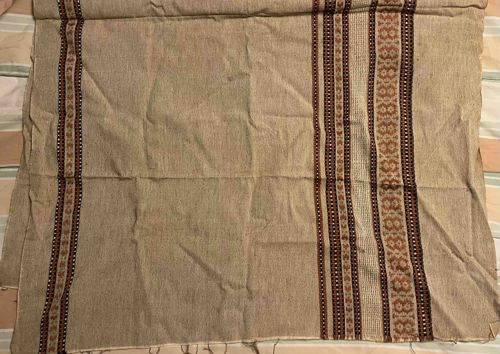
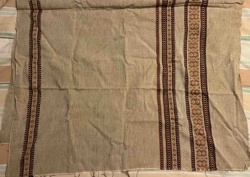
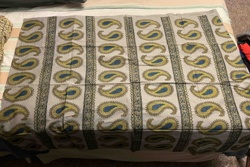
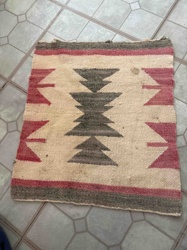
This item is a woven textile, likely a blanket, shawl, or decorative throw, characterized by its natural, undyed warp and weft threads, creating an overall light beige or oatmeal color. The fabric exhibits a visible weave pattern, suggesting a handloom or traditional weaving technique, with some natural slubs and irregularities consistent with natural fibers like cotton, linen, or possibly a blend. It features prominent decorative bands running parallel to each other. The primary decorative band is wider and centrally located within the patterned section, showcasing an intricate geometric motif, possibly stylized flora or abstract shapes, in shades of brown and light brown. This central band is flanked on both sides by narrower stripes in a darker, richer reddish-brown, which are further bordered by very thin, dashed lines that appear to be small embroidered elements or woven dots in contrasting dark and light tones, possibly black and white or dark brown and light beige. The craftsmanship of the decorative bands indicates careful attention to detail, using contrasting colors and textures to create visual interest. The edges of the textile, particularly along one visible end, show signs of unfinished fringe, typical of handwoven pieces. The overall condition appears to be good, with some visible creasing from storage or folding but no obvious tears, stains, or significant damage. The colors seem well-preserved, suggesting minimal fading. The piece appears to be vintage or antique, given the style of weaving and probable natural dyes, possibly dating from the early to mid-20th century or earlier indigenous craftsmanship.
AI Appraisal Report
I have thoroughly examined the provided image of this Handwoven Striped Textile. Based on visual cues, the condition appears good, with minor creasing consistent with storage. I detect no apparent tears, stains, or significant damage, and the colors seem well-preserved. The prominent decorative bands and the visible weave pattern strongly suggest handcrafted artistry, likely from a handloom. The natural slubs and irregularities point to the use of natural fibers. This piece evokes a vintage or antique feel, potentially dating from the early to mid-20th century or reflecting earlier indigenous craftsmanship given the apparent natural dyes and weaving style.
Authenticity: While the visual evidence strongly suggests handwoven origin and age, confirming true authenticity, precise origin (e.g., specific indigenous group, region), and exact age is limited without physical examination. I cannot definitively assess fiber type, dye composition, or weave density from an image alone. Market comparables for handwoven textiles, particularly those with distinct geometric motifs and good condition, typically range widely based on origin, age, and documented provenance. Pieces linked to known artisans or cultures, especially pre-mid-20th century, command higher values.
Demand and Rarity: Handwoven textiles with unique patterns like this often attract collectors interested in folk art, utilitarian textiles, or cultural artifacts. The demand is moderate, but rarity increases significantly with documented historical context or exceptionally fine craftsmanship. Without provenance, this item is a decorative piece, but with provenance, it could become a significant cultural artifact.
Factors impacting value: The primary factors are its apparent age, good condition, and the intricate design. However, the lack of definitive provenance is a significant limitation. To fully authenticate and maximize value, physical examination is crucial to assess fiber, dye types (e.g., natural vs. synthetic), and weave structure. Provenance documentation, connecting it to a specific culture, artisan, or historical period, would be paramount. Scientific testing could pinpoint fiber composition and dye analysis, contributing to a more precise age determination. Without these, my appraisal is based purely on visual inspection.
Limitations: My assessment of authenticity is limited to visual characteristics; I cannot verify materials, origin, or precise age without physical inspection and potentially scientific analysis.