AI estimate as of November 7, 2025 · verify with a professional before acting
AI-Generated · Verify before acting
Everything on this page is generated by AI for informational purposes only. AI can make mistakes — the AI may misidentify items or misattribute them (artist, maker, brand, designer, origin, era). This is not an official valuation and should not be used for insurance, sale, tax, estate, legal, or lending purposes — or any decision requiring a certified appraisal. It is not an authoritative claim about any person, brand, or rights holder — do not share or rely on it as a factual statement about a third party. Always consult qualified professionals before making financial decisions.
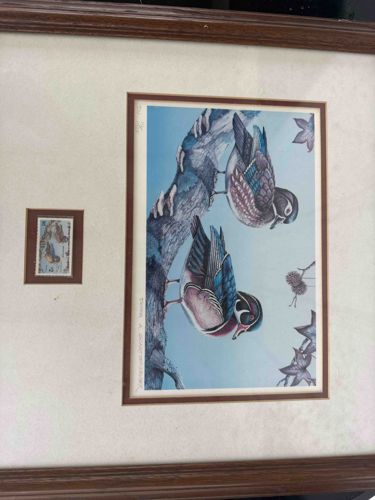
This item is a framed print depicting two wood ducks, titled 'Wood Ducks' and appears to be signed by an artist named 'David A. Maass,' based on the visible signature on the print. The main print features two vibrantly colored wood ducks, one positioned higher on a tree branch and the other below it, both appearing to cling to or be perched on the branch. The background is a soft, light blue, suggesting a sky, with some additional foliage or plant elements in the upper right and lower right corners. The ducks exhibit intricate feather details in shades of blue, green, brown, and a distinctive reddish-pink on their breasts. The print is matted with an off-white or cream-colored matboard, which shows some slight discoloration or dust accumulation, indicating age or exposure. To the left side of the main print, embedded within the same matting, is a smaller, vertically oriented rectangular image. This secondary image appears to be a commemorative stamp, also featuring a bird, likely a duck or similar waterfowl, maintaining a consistent theme with the main artwork. Both the print and the stamp are housed within a dark brown wooden frame, which has a visible wood grain and a slightly rounded profile. The frame exhibits some minor wear, consistent with handling and age, but no significant damage is immediately apparent. The overall presentation suggests a limited edition print, possibly a 'duck stamp' print, which are common collectibles in wildlife art. The craftsmanship of the framing seems standard, designed to protect and display the artwork and stamp.
AI Appraisal Report
Based on my visual examination of the provided image, this Framed 'Wood Ducks' Print with Accompanying Stamp, signed 'David A. Maass,' appears to be a classic example of a federal or state duck stamp print. The print itself seems to be in good condition, with vibrant colors and details, characteristic of Maass's work. The accompanying stamp, often issued alongside these prints, further supports its identity as a wildlife art collectible. The matting shows some discoloration or dust, suggesting age or environmental exposure, which is a minor detractor but can often be improved with re-matting. The dark brown wooden frame, while showing minor wear, is consistent with typical framing for such pieces and does not appear to have significant damage.
Authenticity of the signature 'David A. Maass' cannot be definitively verified from an image alone; an in-person examination, comparing it to known authentic signatures, would be required. Similarly, verifying it as a legitimate 'limited edition' print (e.g., matching edition number to known records) would necessitate physical inspection. The condition of the print and stamp within the frame seems sound, but any foxing, fading, or damage to the print itself beneath the mat cannot be assessed without physical inspection.
Market conditions for duck stamp prints vary. While demand for works by renowned wildlife artists like David A. Maass remains steady, the overall market for secondary duck stamp prints has seen fluctuations. Rarity is generally tied to the edition size and the specific year of issue.
Factors impacting value include the artist's reputation (high here), the condition of the print and stamp (good based on visual), the edition number (unknown), and the completeness of the set (print and stamp present). Higher values are typically associated with earlier, lower edition numbers and prints in pristine condition. Without being able to inspect the piece in person to check for hidden flaws, verify edition information, and authenticate the signature, my appraisal is based on the assumption of a legitimate Maass print in good, but not perfect, condition. Provenance documentation, such as original purchase receipts or certificates of authenticity, would greatly assist in a more precise valuation.