Amethyst Quartz Druzy Geode Segment
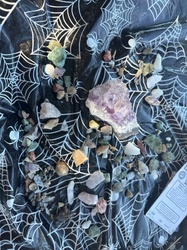
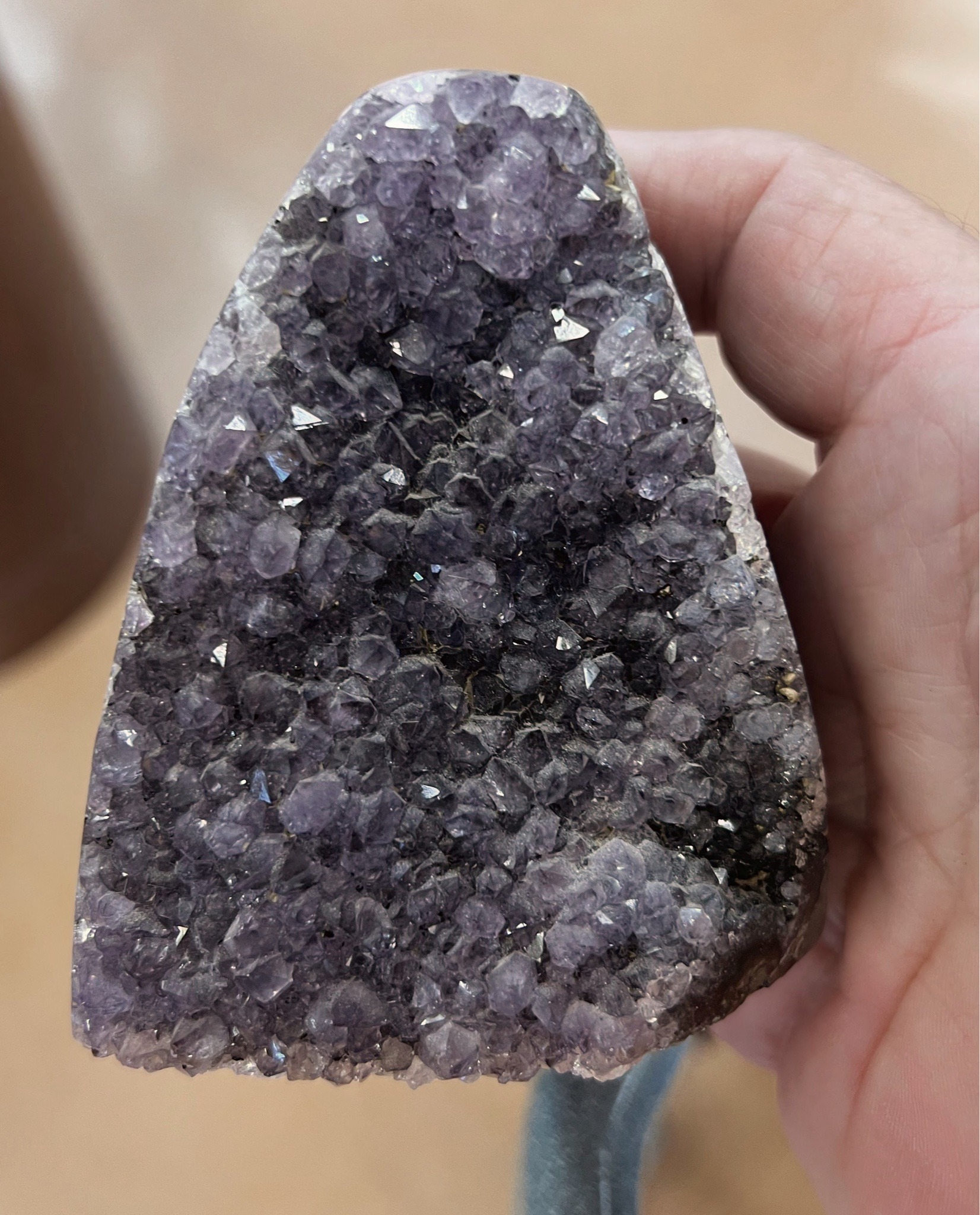
This specimen is a natural amethyst quartz geode section, standing in a self-displaying arched vertical orientation. The piece measures approximately 4 to 5 inches in height, fitting comfortably in a hand. It features a dense carpet of small-to-medium druzy quartz crystals exhibiting a medium-to-deep purple saturation. The color is most intense toward the center and top of the arched interior, transitioning to a pale, translucent lavender near the outer edges. The crystals show sharp, pyramidal terminations with a high vitreous (glass-like) luster that reflects light effectively. The outer matrix or 'rind' appears to be a thin layer of gray-to-brown host rock, likely basalt or agate, which has been cut and polished on the sides and bottom to allow the piece to stand upright. Condition-wise, the specimen is in good natural state, though there is visible dark particulate or mineral inclusions trapped between several crystal points, particularly in the lower-right quadrant. No significant fracturing or major repairs are evident, though minor edge chipping is common for naturally harvested minerals. The item represents a classic example of quartz volcanic cavitation, commonly sourced from the basalt deposits of Brazil or Uruguay.
AI-Generated Appraisal Disclaimer
Estimated Value
$45.00 - $65.00
Basic Information
Category
Minerals and Gemstones
Appraised On
April 21, 2026
Estimated Value
$45.00 - $65.00
Item Description
This specimen is a natural amethyst quartz geode section, standing in a self-displaying arched vertical orientation. The piece measures approximately 4 to 5 inches in height, fitting comfortably in a hand. It features a dense carpet of small-to-medium druzy quartz crystals exhibiting a medium-to-deep purple saturation. The color is most intense toward the center and top of the arched interior, transitioning to a pale, translucent lavender near the outer edges. The crystals show sharp, pyramidal terminations with a high vitreous (glass-like) luster that reflects light effectively. The outer matrix or 'rind' appears to be a thin layer of gray-to-brown host rock, likely basalt or agate, which has been cut and polished on the sides and bottom to allow the piece to stand upright. Condition-wise, the specimen is in good natural state, though there is visible dark particulate or mineral inclusions trapped between several crystal points, particularly in the lower-right quadrant. No significant fracturing or major repairs are evident, though minor edge chipping is common for naturally harvested minerals. The item represents a classic example of quartz volcanic cavitation, commonly sourced from the basalt deposits of Brazil or Uruguay.
Get Your Items Appraised
Instant estimates of your treasures with AI-powered instant appraisals