AI estimate as of August 26, 2025 · verify with a professional before acting
AI-Generated · Verify before acting
Everything on this page is generated by AI for informational purposes only. AI can make mistakes — the AI may misidentify items or misattribute them (artist, maker, brand, designer, origin, era). This is not an official valuation and should not be used for insurance, sale, tax, estate, legal, or lending purposes — or any decision requiring a certified appraisal. It is not an authoritative claim about any person, brand, or rights holder — do not share or rely on it as a factual statement about a third party. Always consult qualified professionals before making financial decisions.
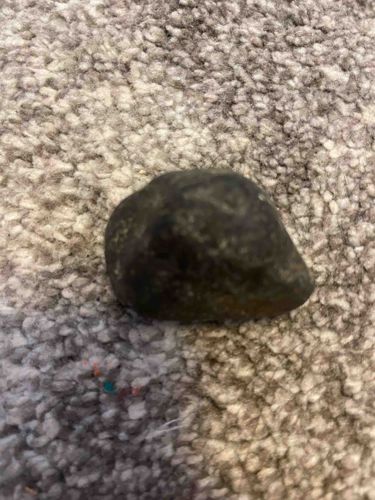
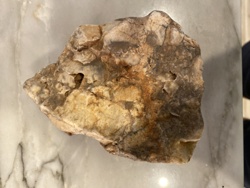
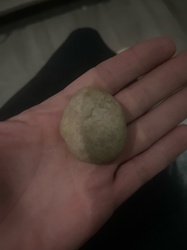
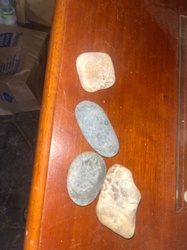
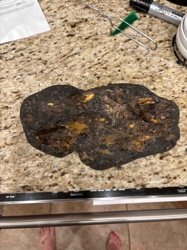
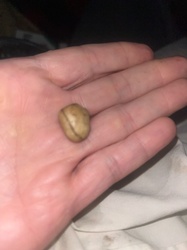
The item appears to be a small, dark-colored river rock or pebble. It has an irregular, somewhat oblong shape with smoothed, rounded edges, indicative of prolonged exposure to erosion, likely from water. The primary color is a dark, mottled gray or charcoal brown, with some lighter specks and possibly some subtle reddish-brown or greenish tinges integrated into its surface, suggesting mineral variations or environmental deposits. The surface texture seems slightly uneven but generally smooth to the touch, without sharp angles or prominent facets. There are no discernible markings, deliberate carvings, or manufacturing details such as maker's marks or signatures visible from the provided images. Given its natural form and lack of artificial modifications, it is likely a found object rather than a manufactured one. Its condition appears stable, with no visible cracks, chips, or significant damage; any 'wear' is part of its natural formation process (patina). Its estimated age is geological, having formed over a very long period, and its immediate history as a 'found object' is unknown. Its quality is inherent to its natural state, representing a typical example of a water-worn stone.
AI Appraisal Report
Upon visual examination of the provided image, I assess this river rock/pebble to be a natural specimen in excellent, stable condition. Its smoothed, rounded edges and irregular oblong shape are consistent with prolonged water erosion, confirming its authenticity as a natural river stone. The dark, mottled gray/charcoal brown color with subtle variations is typical of such geological formations. There are no visible chips, cracks, or artificial markings, indicating its pristine natural state.
Market conditions for common river rocks are generally very low. While decorative pebbles are sold in bulk for landscaping or craft purposes, individual, unexceptional stones like this one hold little monetary value in collector markets. Comparables would include similar naturally occurring stones found in various riverbeds globally, which are abundant and readily accessible. There is no significant rarity or unique characteristic that would drive demand for this particular specimen beyond its natural aesthetic. Factors significantly impacting value would typically be exceptional size, unique mineral composition, striking coloration, or a documented historical association, none of which are evident here.
Based solely on the image, I cannot definitively ascertain its precise geological origin or mineral composition beyond general observation. Full authentication would require physical examination to verify tactile properties, weight, and density, and potentially scientific testing (e.g., elemental analysis) to confirm mineralogy, though such extensive testing would be disproportionate to the item's inherent value. Provenance documentation would also be needed if there were claims of a significant discovery location or historical significance, none of which are suggested here. Without these, it remains a common, naturally beautiful stone.