These notes were written by the person who submitted this item. Appraiser.AI has not verified them, and the AI's identification and estimate may rely on them.
AI Estimated Value
Not an official valuation
$600-900
AI estimate as of July 14, 2025 · verify with a professional before acting
AI-Generated · Verify before acting
Everything on this page is generated by AI for informational purposes only. AI can make mistakes — the AI may misidentify items or misattribute them (artist, maker, brand, designer, origin, era). This is not an official valuation and should not be used for insurance, sale, tax, estate, legal, or lending purposes — or any decision requiring a certified appraisal. It is not an authoritative claim about any person, brand, or rights holder — do not share or rely on it as a factual statement about a third party. Always consult qualified professionals before making financial decisions.
This analysis also relies on unverified notes provided by the user, which may be incomplete or inaccurate and could affect the result.
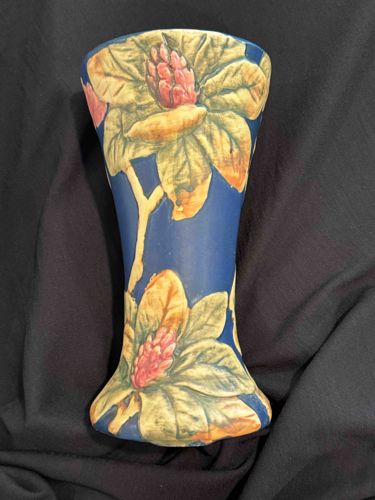
The item is a ceramic vase, likely made of pottery or stoneware, featuring a flared-lip cylindrical body that slightly tapers towards the bottom before flaring out again to a stable base. The dominant color of the vase's body is a matte or satin finish royal blue, providing a striking background for the raised floral decoration. The ornamentation consists of large, lobed leaves rendered in shades of cream, light yellow, and faded orange, with distinct veining that adds texture and depth. Interspersed among the leaves are prominent, ovoid flower buds or fruit forms, colored in a vibrant reddish-pink, suggesting a botanical motif such as magnolias or a specific ginger variety. The stems or branches of the plant are depicted in a muted yellow or beige, contrasting subtly with the blue ground. The decoration appears to be achieved through a molded relief technique, possibly with hand-painted accents to enhance the colors and details, indicating good craftsmanship. There are no readily visible chips, cracks, or extensive wear patterns, suggesting a well-preserved condition for its probable age. The surface appears clean and free from significant grime or repairs. The overall aesthetic points towards an Art Nouveau or early Art Deco period influence, likely dating from the late 19th to early 20th century. The quality of the molding and the careful application of color suggest a manufactured piece from a reputable pottery producer, although no specific maker's marks are visible in the provided image.
AI Appraisal Report
Upon examining the provided image and the owner's description of 'Excellent' condition, I assess this Blue Floral Relief Ceramic Vase. The form, with its flared-lip cylindrical body tapering to a stable base, coupled with the raised floral decoration, strongly suggests an Art Nouveau or early Art Deco period influence, likely late 19th to early 20th century. The striking royal blue matte finish serves as an excellent backdrop for the beautifully rendered cream, yellow, and orange leaves with distinct veining, and the vibrant reddish-pink ovoid flower buds. The muted yellow/beige stems complete what appears to be a sophisticated botanical motif.
From the image, the condition appears excellent, aligning with the owner's assessment; I observe no visible chips, cracks, or significant wear. This indicates good preservation, which is a major positive factor for value. The quality of the molded relief and apparent hand-painted accents point to good craftsmanship and a likely reputable pottery producer.
In terms of market conditions, Art Nouveau/Art Deco ceramics with strong visual appeal and good condition are consistently sought after. Comparables for pieces of this quality and suspected age, especially those with such vibrant and well-preserved relief work, typically perform well. Demand for decorative arts from this period remains steady, and the uniqueness of the design, combined with its apparent rarity in this condition, adds to its appeal.
However, it is crucial to note that this appraisal is based entirely on visual examination of an image and provided text. I cannot definitively verify authenticity or condition without a direct, in-person examination. Physical inspection would allow me to assess the tactile quality of the ceramic, the true nature of the finish (matte, satin), and detect any subtle repairs or restoration not visible in photographs. Furthermore, a thorough physical examination would involve searching for any hidden maker's marks, impressed numbers, or signatures that could definitively attribute the piece to a specific well-known manufacturer like Rookwood, Weller, or Roseville, which would significantly impact its value. Scientific testing, such as thermoluminescence dating, could confirm the age, and chemical analysis of glazes could further aid in attribution. Without these, authentication remains provisional.
Given the apparent excellent condition and strong aesthetic, suggesting a good quality piece from the period, the preliminary value is estimated.