AI identification & appraisal estimate

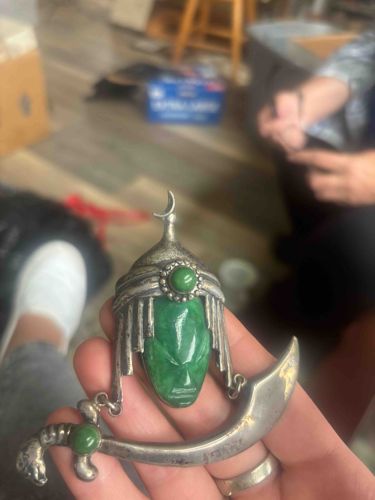
Middle Eastern Style Brooch/Pendant with Carved Green Stone Face and Scimitar

This name is the AI's identification of the item — it may be incorrect.

Submitted photo of Middle Eastern Style Brooch/Pendant with Carved Green Stone Face and Scimitar
Photo submitted by the user — not generated by AI

User's notes

Ivory

These notes were written by the person who submitted this item. Appraiser.AI has not verified them, and the AI's identification and estimate may rely on them.

AI Estimated Value

Not an official valuation

$40-$70

AI estimate as of August 2, 2025 · verify with a professional before acting

AI-Generated · Verify before acting

Everything on this page is generated by AI for informational purposes only. AI can make mistakes — the AI may misidentify items or misattribute them (artist, maker, brand, designer, origin, era). This is not an official valuation and should not be used for insurance, sale, tax, estate, legal, or lending purposes — or any decision requiring a certified appraisal. It is not an authoritative claim about any person, brand, or rights holder — do not share or rely on it as a factual statement about a third party. Always consult qualified professionals before making financial decisions.

This analysis also relies on unverified notes provided by the user, which may be incomplete or inaccurate and could affect the result.

Read the full disclaimer

AI Item Analysis

This item is a brooch or pendant featuring a design inspired by Middle Eastern or North African aesthetics. It is primarily constructed from a silver-toned metal, likely sterling silver given its appearance and natural tarnishing, paired with two vibrant green gemstone elements, most likely carved jade or a jade simulant. The central motif is a carved green face, possibly depicting a stylized human or deity figure, set within a headdress-like structure made of the silver-toned metal. This headdress features a domed top adorned with a small, crescent moon finial and a circular green cabochon surrounded by a beaded setting at its base. The headdress also incorporates multiple dangling, elongated silver-toned pieces that frame the carved face. The carved face itself is highly stylized with prominent brows and a defined nose, presenting a somewhat stern or enigmatic expression. Attached to the lower left side of the headdress element is a hinged or suspended component in the shape of a curved saber or scimitar. The hilt of the saber is adorned with an additional small green cabochon corresponding to the one on the headdress. The silver-toned metal exhibits a noticeable patina and some minor scratches consistent with age and wear, particularly visible on the flat surface of the saber where the metal appears slightly dulled and shows signs of rubbing. No discernible maker's marks or hallmarks are clearly visible in the provided images, but the inscription 'JAPAN' is faintly etched on the blade of the saber, indicating its origin. The overall craftsmanship suggests a mass-produced item rather than a unique artisan piece, though the carving of the face shows some detail. Based on the style, materials, and visible 'JAPAN' marking, this piece likely dates from the mid-20th century, possibly the 1950s to 1970s, when such exotic-themed jewelry was popular.
AI Appraisal Report

Upon examining this Middle Eastern-style brooch/pendant, my assessment of its condition is good, exhibiting age-appropriate wear including tarnishing and minor surface scratches, particularly on the saber. The faint 'JAPAN' etching on the blade is a crucial indicator of origin, suggesting this is a mass-produced piece from the mid-20th century. The green stones, likely jade simulant rather than genuine jade, and absence of clear sterling silver hallmarks suggest base metal, despite its silver-toned appearance. Authenticity of material cannot be definitively confirmed without in-person inspection and potential testing for metal content and specific gravity of the stones. Market conditions for vintage costume jewelry with exotic themes are steady, but a piece like this, without precious metal content or identifiable designer, typically occupies the lower end of the spectrum. Demand is niche, primarily from collectors of vintage costume jewelry or those seeking unique, decorative pieces. Factors impacting value significantly include the likely non-precious metal construction, and the 'JAPAN' mark which, while providing origin, also points to mass production. Rarity is not a major factor as similar themed items were common during its likely production era. For full authentication and to ascertain material composition, an in-person examination, including potential XRF testing for metal and specific gravity testing for the stones, would be necessary. Provenance documentation would also be valuable but is often unavailable for such items.

Keep exploring

More jewelry/accessory appraisals

Get your items appraised

Instant AI-powered appraisal estimates from a photo

Browse More Appraisals