AI estimate as of November 7, 2025 · verify with a professional before acting
AI-Generated · Verify before acting
Everything on this page is generated by AI for informational purposes only. AI can make mistakes — the AI may misidentify items or misattribute them (artist, maker, brand, designer, origin, era). This is not an official valuation and should not be used for insurance, sale, tax, estate, legal, or lending purposes — or any decision requiring a certified appraisal. It is not an authoritative claim about any person, brand, or rights holder — do not share or rely on it as a factual statement about a third party. Always consult qualified professionals before making financial decisions.
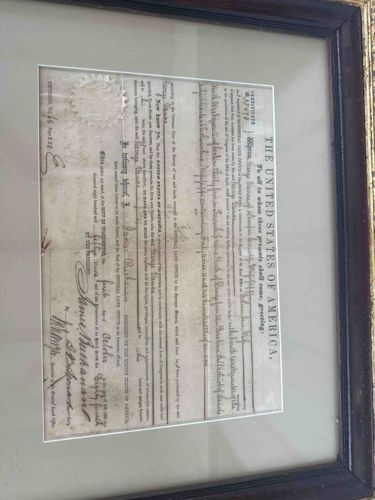
This item is a framed historical document, specifically a land grant or patent, issued by 'THE UNITED STATES OF AMERICA' and bearing the signature of James Buchanan, who served as the 15th President of the United States. The document is presented within a dark wooden frame with a gold-toned inner edge, and is matted with a light, possibly off-white or cream-colored mat board, typical of vintage framing styles. The document itself appears to be printed on aged paper, exhibiting a uniform yellowish-tan discoloration consistent with its age. Handwritten details fill in the blanks of the printed form, including what appears to be a certificate number '437418' at the top left. The text is in a formal, cursive script for the handwritten portions and a classic serif typeface for the printed sections. A distinctive embossed seal, likely a federal land office seal, is visible on the left side of the document, indicating its official nature. The document shows signs of age, including potential creases, subtle foxing, and general wear typical for paper of this vintage. The corners appear slightly softened or rounded, and there might be some minor surface irregularities. The signature of 'James Buchanan' is clearly discernible towards the bottom right, a key feature that significantly adds to its historical value. The style suggests it dates from the mid-19th century, specifically during Buchanan's presidency (1857-1861). The craftsmanship of the document itself reflects the standards of official government printing and engrossing of the period, while the framing is a later addition to preserve and display the piece.
AI Appraisal Report
Upon examining the provided image of this Presidential Land Grant Document signed by James Buchanan, I assess its authenticity and condition. The document appears consistent with a mid-19th century land patent, featuring aged paper with uniform discoloration, formal script, and a visible embossed seal. The signature of 'James Buchanan' is clearly discernible and appears authentic based on visual comparison with known examples. However, a conclusive authentication of the signature would require in-person examination by a forensic document examiner.
The document exhibits typical age-related wear, including potential creases, subtle foxing, and surface irregularities, all consistent with its vintage and handling over time. The framing, while a later addition, seems to have protected the document fairly well. The certificate number '437418' is a unique identifier, and the handwritten details suggest it was officially completed.
Presidential land grants, especially those signed by less common presidents, hold significant historical value. Buchanan's presidency (1857-1861) was a turbulent period leading to the Civil War, adding a layer of historical context. Documents bearing his signature are scarcer than those from more prominent presidents like Lincoln or Washington. The market for presidential autograph material is generally strong, with land grants being a desirable form of signed document.
Demand for such historical artifacts is consistent among collectors of presidential memorabilia, Americana, and land/legal history. Rarity is moderate; while Buchanan's presidential documents are not exceedingly rare, they are less common than those of, for example, Andrew Jackson or Ulysses S. Grant. Factors significantly impacting value include the clear signature, the overall good visual condition (despite age), and the framed presentation.
Limitations in authenticity verification from images alone are important to note. A full authentication would require physical examination to verify paper type, ink composition, the legitimacy of the embossed seal, and a detailed analysis of the signature's pressure and flow. Provenance documentation, if available, would further enhance value and confirm authenticity beyond doubt. Without physical inspection, precise condition assessment (e.g., tears, repairs, exact foxing severity) is also difficult.