These notes were written by the person who submitted this item. Appraiser.AI has not verified them, and the AI's identification and estimate may rely on them.
AI Estimated Value
Not an official valuation
$10-30
AI estimate as of October 3, 2025 · verify with a professional before acting
AI-Generated · Verify before acting
Everything on this page is generated by AI for informational purposes only. AI can make mistakes — the AI may misidentify items or misattribute them (artist, maker, brand, designer, origin, era). This is not an official valuation and should not be used for insurance, sale, tax, estate, legal, or lending purposes — or any decision requiring a certified appraisal. It is not an authoritative claim about any person, brand, or rights holder — do not share or rely on it as a factual statement about a third party. Always consult qualified professionals before making financial decisions.
This analysis also relies on unverified notes provided by the user, which may be incomplete or inaccurate and could affect the result.
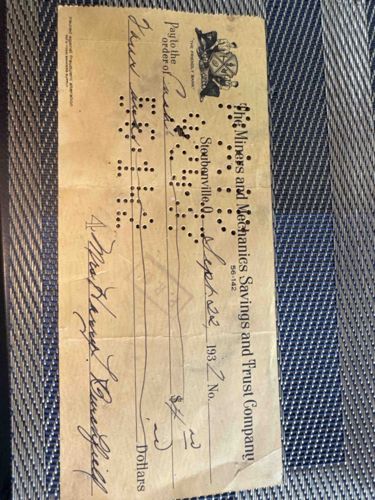
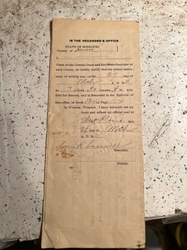
This item is an antique or vintage bank check, specifically a voided check, issued by 'The Miners and Mechanics Savings and Trust Company' located in Steubenville, Ohio. The check is made of thin, light brown or cream-colored paper, typical of banking documents from the early 20th century. Its dimensions appear to be standard for a check of that era, generally rectangular, though precise measurements are not available from the image. The most prominent feature is the series of perforations or punched holes across the center of the check, which is a common method for voiding a document to prevent fraudulent use or to mark it as processed and no longer valid. The printed details on the check include the bank's name and location, with a stylized 'M' logo showing miners and a wheel, likely representing mechanics, indicating the institution's historical ties to industrial workers. The date 'Sept 22 1932' is clearly written, establishing its age. Other printed elements include 'Pay to the order of,' a line for the payee, and 'Dollars' for the amount in numerals and text. There's also a printed check number ('No.') and a bank transit number '56-142'. Handwritten elements include a payee, possibly 'Cash' or a similar term, and a signature 'Mrs. Hervey Kinegfield' at the bottom right. The check exhibits significant wear consistent with its age, including creases, folds, and possibly some discoloration or foxing across the paper surface. The edges appear somewhat softened or slightly frayed. Overall, it is in 'used' or 'good' condition for a paper artifact of its age, considering the inherent fragility of old paper. The presence of the perforations confirms its voided status. This item serves as a historical artifact, offering insight into banking practices, local institutions, and handwriting styles of the 1930s.
AI Appraisal Report
I have carefully examined the provided image of this voided check from The Miners and Mechanics Savings and Trust Company, dated September 22, 1932. The item appears authentic as a historical banking document, consistent with the design and paper quality typical of the 1930s. The prominent perforations confirm its voided status, which is a common feature for such artifacts and does not inherently diminish its historical value, though it removes any financial redeemability. The condition, judging from the image, is "good" to "fair" for an item of its age, exhibiting expected wear including creasing, folds, and some discoloration. The 'Mrs. Hervey Kinegfield' signature and the bank's distinctive logo add to its unique character.
Market conditions for voided or cancelled historical checks are generally modest. While they are interesting historical ephemera, they typically do not command high prices unless associated with a significant historical event, person, or a particularly rare bank. Comparables in the market, often found on online auction sites or in specialized paper collectibles shops, suggest that voided checks from regional banks of this era usually fall into a relatively low price bracket. Demand is niche, primarily from local history enthusiasts, collectors of banking memorabilia, or those interested in early 20th-century ephemera. Rarity is not particularly high for a standard voided check of this type from a regional institution. The primary value drivers are the bank's unique name/logo and the specific date during the Great Depression.
It is important to note that this appraisal is based solely on visual examination of the image and the provided description. A full authentication would require physical inspection to assess paper quality, ink composition, and precise determination of wear and tear. Examination under magnification could confirm printing techniques and rule out modern reproductions. Provenance documentation, such as where and how the check was acquired, would also strengthen its authentication, but for a common item like this, such documentation is rarely available or necessary for its established market value.