AI estimate as of November 7, 2025 · verify with a professional before acting
AI-Generated · Verify before acting
Everything on this page is generated by AI for informational purposes only. AI can make mistakes — the AI may misidentify items or misattribute them (artist, maker, brand, designer, origin, era). This is not an official valuation and should not be used for insurance, sale, tax, estate, legal, or lending purposes — or any decision requiring a certified appraisal. It is not an authoritative claim about any person, brand, or rights holder — do not share or rely on it as a factual statement about a third party. Always consult qualified professionals before making financial decisions.
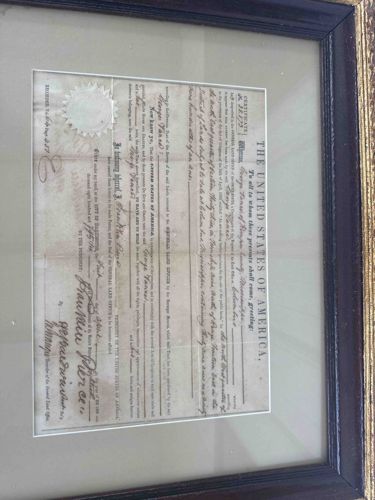
This item is a framed historical document, specifically a United States Land Patent, dating to 1855. The document is presented under glass, within a dark wooden frame with an ornate, possibly gilded, inner edge, and a light-colored matting that surrounds the document itself. The patent appears to be an official governmental record, likely printed on parchment or heavy paper, which has aged to an off-white or cream color, indicating its significant age. The text on the document is a mix of pre-printed and handwritten sections, typical of such official forms from the 19th century. Notable handwritten elements include names like 'George Vincent' and the date '1855', which is clearly visible. A key feature is the signature of 'Franklin Pierce', who served as the 14th President of the United States from 1853 to 1857. Below his signature, an embossed or raised governmental seal is visible on the left side of the document, adding to its authenticity. The document exhibits signs of aging consistent with its estimated age, including some discoloration, minor creasing or subtle folds, and a general antique patina. The frame itself appears to be in good condition for its age, though the gilded inner edge shows some wear through light reflections, suggesting minor rubbing or loss of gilding. The overall presentation is well-preserved, indicating an intention to display and protect this historical artifact. This land patent represents a significant piece of American history, connecting to the expansion and settlement of the United States during the mid-19th century and featuring the autograph of a former president, making it a valuable collectible.
AI Appraisal Report
I have examined the image of this Framed 1855 United States Land Patent Signed by President Franklin Pierce. Visually, the document appears to be in very good condition for its age, displaying typical discoloration and an antique patina consistent with an 1855 artifact. There are minor creases or folds, but no overt tears or significant damage visible through the glass. The ornate frame and matting provide a suitable protective and aesthetic presentation. The presence of both pre-printed and handwritten sections, including 'George Vincent' and the prominent '1855' date, aligns with authentic land patents of the period.
Key to its value is the apparent signature of Franklin Pierce, the 14th U.S. President. The embossed governmental seal further enhances its perceived authenticity and official nature. Historically, presidential land grant documents are highly collectible, particularly those signed by lesser-represented presidents or figures with unique historical contexts. Comparing to similar presidential signed land patents on the market, documents signed by presidents like Pierce, whose terms were less eventful than others but still historically significant, generally command strong prices. Demand for presidential autographs, especially on official documents highlighting governmental duties, remains consistently robust. The rarity is moderate; while not unique, authentic signed presidential land patents from this era are not commonly encountered.
Factors significantly impacting value include the clear signature, the well-preserved condition of the document itself, and the overall attractive framing. However, it is crucial to note the limitations of image-based appraisal. While the signature *appears* consistent with known examples of Franklin Pierce's autograph, definitive authentication would require an in-person examination by a qualified expert in presidential autographs. Proper provenance documentation, detailing the document's history of ownership, would also significantly bolster its value. Scientific testing, such as ink analysis, could also confirm the age of the signature. Without these, the authenticity of the signature, and thus a major component of its value, relies on visual assessment only.