AI estimate as of September 22, 2025 · verify with a professional before acting
AI-Generated · Verify before acting
Everything on this page is generated by AI for informational purposes only. AI can make mistakes — the AI may misidentify items or misattribute them (artist, maker, brand, designer, origin, era). This is not an official valuation and should not be used for insurance, sale, tax, estate, legal, or lending purposes — or any decision requiring a certified appraisal. It is not an authoritative claim about any person, brand, or rights holder — do not share or rely on it as a factual statement about a third party. Always consult qualified professionals before making financial decisions.
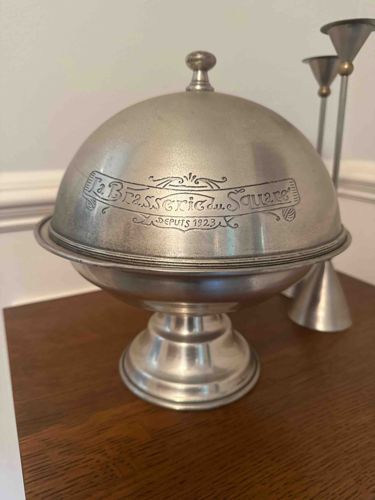
This item is a vintage covered dish, likely used as a butter dish or for serving small appetizers, constructed entirely of a silvery-toned metal, possibly pewter or silverplate, showing an aged patina. The dish features a classic cloche-style dome lid with a small, round finial for lifting. A prominent etched or engraved banner across the center of the dome reads "La Brasserie du Square" in an elegant, flowing script, with the inscription "DEPUIS 1923" (meaning 'Since 1923') directly below it, suggesting an establishment's branding and a long history. The lid sits atop a shallow, circular bowl, which in turn is supported by a spreading pedestal base with subtle rings along its profile. The overall construction appears sturdy, with a solid, weighty feel. The metal exhibits a dull, matte finish with areas of darker tarnish and minor scuffs, indicative of its age and use over time. There are no obvious dents or significant damage, but the surface shows consistent wear commensurate with a vintage item. The craftsmanship suggests a commercial-grade piece, perhaps from a French brasserie, given the inscription. The style points to an early to mid-20th-century origin, aligning with the "1923" date. Its unique branding makes it a distinctive piece of restaurant ephemera or memorabilia, adding to its potential historical and collectible value.
AI Appraisal Report
I've examined the provided image of this vintage 'La Brasserie du Square Depuis 1923' covered dish. Visually, the condition appears consistent with a well-used vintage piece, exhibiting an aged patina, tarnish, and minor scuffs. There are no obvious dents or significant damage, which is a positive. The styling strongly suggests an early to mid-20th-century origin, aligning with the '1923' inscription. The inscription itself, 'La Brasserie du Square Depuis 1923,' adds significant character and historical appeal, indicating it was likely a branded piece from a French establishment. This type of restaurant ephemera has a niche market among collectors of culinary history, French memorabilia, or vintage kitchenware.
Market conditions for vintage branded restaurant items can vary. While not exceptionally rare, pieces with specific branding like this have a dedicated following. Comparable items, such as other vintage commercial butter dishes or covered serving pieces, often sell in the $50-$150 range, with branded pieces at the higher end. The material, which appears to be silverplate or pewter, contributes to its perceived quality, though without physical inspection, I cannot confirm the exact metal composition. Silverplate would typically fetch a slightly higher value than pewter.
Demand is moderate for such specific items. Rarity is enhanced by the unique brasserie branding. The lack of significant damage and legible inscription are strong value factors. However, several factors limit its top value: without physical examination, I cannot test for silver content, assess structural integrity beyond what's visible, or definitively confirm its age beyond stylistic cues. An in-person inspection would allow for metal testing, closer examination of craftsmanship, and assessment of any maker's marks, which would be crucial for full authentication and a more precise valuation. Without provenance documentation directly tying it to 'La Brasserie du Square,' its authenticity as an original commercially used piece remains an assumption based on its appearance.