AI estimate as of August 31, 2025 · verify with a professional before acting
AI-Generated · Verify before acting
Everything on this page is generated by AI for informational purposes only. AI can make mistakes — the AI may misidentify items or misattribute them (artist, maker, brand, designer, origin, era). This is not an official valuation and should not be used for insurance, sale, tax, estate, legal, or lending purposes — or any decision requiring a certified appraisal. It is not an authoritative claim about any person, brand, or rights holder — do not share or rely on it as a factual statement about a third party. Always consult qualified professionals before making financial decisions.
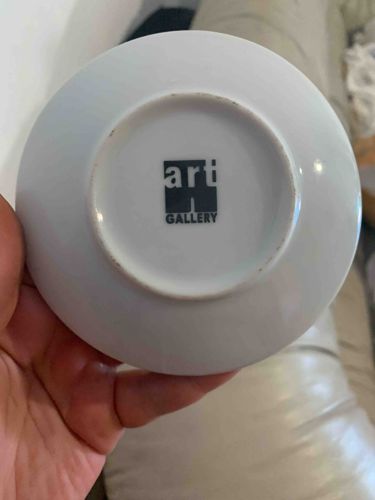
The item appears to be the underside of a small, white, circular ceramic or porcelain piece, likely a cup saucer or a small plate, due to its flat, raised center and slightly concave form. Its physical characteristics include a smooth, glossy white glaze, typical of modern dinnerware. The primary distinguishing feature is the manufacturer's mark or branding, centrally located on the underside. This mark reads "art" in a sans-serif lowercase font, with a solid black square or block beneath it that contains the word "GALLERY" in white, all-caps sans-serif lettering. The overall design of the mark suggests a contemporary aesthetic, possibly dating from the late 20th or early 21st century. There are no obvious signs of significant damage, cracks, or repairs. A small amount of what appears to be minor dirt or residue is visible along the inner edge of the raised central ring, suggesting some previous use or storage with light accumulation. The craftsmanship appears to be standard for mass-produced ceramic items, with a consistent glaze and clear, applied transfer for the maker's mark. The piece's size can only be estimated relative to the hand holding it, but it appears to be designed for a single serving or as part of a tea/coffee set. The 'Art Gallery' branding might indicate it was part of a promotional item, museum gift shop merchandise, or a line of artistic-themed tableware.
AI Appraisal Report
Upon my virtual inspection of this ceramic saucer, I assess its condition as very good, showing only minor signs of use, such as light surface residue along the inner ring, but no chips, cracks, or significant wear to the glaze or maker's mark. The mark itself appears to be a clear, well-applied transfer, lending credence to its authenticity as a mass-produced item.
Market conditions for generic white ceramic dinnerware, even with distinct branding, are generally low unless associated with a high-end designer, limited edition art series, or significant historical provenance. Comparables in the secondary market for single miscellaneous saucers from general 'art gallery' or similar retail lines typically fetch minimal prices. Given the 'Art Gallery' branding, this likely falls into the category of promotional merchandise or lower-tier gift shop items, which rarely accrue significant collectible value. Demand is low for individual pieces of this nature, and rarity is negligible as such items are usually produced in large quantities.
The primary factor significantly impacting its value, or lack thereof, is its commonality and lack of intrinsic artistic or historical merit beyond its basic function. There's no indication of high-quality porcelain or artisanal craftsmanship that would elevate its worth.
My assessment for authenticity is limited to visual cues. While the mark appears genuine for what it is, full authentication would require physical examination to assess glaze quality, firing techniques, and the application method of the mark (e.g., decal vs. underglaze print). Provenance documentation, such as where and when it was acquired, would also be beneficial to confirm its origin and any associated artistic or institutional significance, though I expect none here. Scientific testing is unwarranted for an item of this type and estimated value.