AI estimate as of September 22, 2025 · verify with a professional before acting
AI-Generated · Verify before acting
Everything on this page is generated by AI for informational purposes only. AI can make mistakes — the AI may misidentify items or misattribute them (artist, maker, brand, designer, origin, era). This is not an official valuation and should not be used for insurance, sale, tax, estate, legal, or lending purposes — or any decision requiring a certified appraisal. It is not an authoritative claim about any person, brand, or rights holder — do not share or rely on it as a factual statement about a third party. Always consult qualified professionals before making financial decisions.
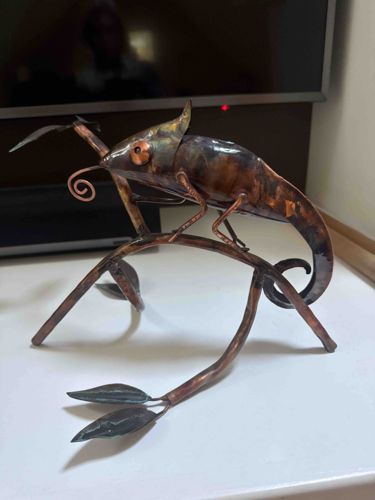
This is a detailed metal sculpture depicting what appears to be a large insect, possibly an interpretation of a grasshopper, cricket, or preying mantis, perched on a branch. The sculpture is constructed primarily from sheet metal and wire, exhibiting a rich, multi-toned patination that combines coppery reds, bronze browns, and areas of darker blackish-green, suggesting intentional chemical treatment or natural aging of the metal, likely copper or a copper alloy. The insect itself is elongated, featuring a distinguishable head with prominent, stylized eyes, a cone-shaped protrusion on top, and a curled antenna-like element emanating from the front. Its body is segmented, tapering towards a curved tail. Delicate wire-like legs extend from the body, gripping a sculpted branch. The branch itself is artfully rendered with several stylized leaves, also exhibiting similar patination, and features scrolled ends for stability and aesthetic appeal. The construction appears to be a combination of soldering or welding techniques for joining the metal pieces, along with bending and shaping of the sheet and wire. There are no obvious signs of significant damage like breaks or large dents, though minor surface wear consistent with age and handling may be present within the patinated finish. The craftsmanship suggests a folk art or studio craft aesthetic, emphasizing textural and color variation over hyper-realistic detail. Its visual characteristics point towards a mid-to-late 20th-century origins, perhaps from the 1960s-1980s, a period when such metal art was popular as decorative household items. The overall condition appears good, with the patina being a key part of its intended aesthetic.
AI Appraisal Report
Based on my visual examination of the provided image, this Patinated Metal Insect Sculpture on Branch appears to be in good overall condition. The multi-toned patination, combining coppery reds, bronze browns, and darker blackish-green, seems consistent with intentional chemical treatment or natural aging, and is integral to its aesthetic. I see no obvious signs of significant damage like breaks or large dents. The craftsmanship, evident in the detailed insect and stylized branch with leaves, suggests a studio craft or folk art origin. The construction methods, likely soldering or welding, bending, and shaping, appear well-executed.
Market conditions for such decorative metal sculptures from the mid-to-late 20th century, particularly those in the folk art style, are generally stable but not exceptionally strong, unless attributed to a known artist. Comparables often sell in the low to mid-hundreds depending on size, artist recognition, and complexity. Demand is moderate, appealing to collectors of vintage decorative arts or those furnishing spaces with a rustic or industrial aesthetic. Rarity for unsigned pieces like this is not high, as many similar items were produced during the period. Factors impacting value include the appealing patination, intricate detail, and overall good condition.
My assessment of authenticity is based solely on visual cues from the image. While the style and construction are consistent with the described period, a definitive artist attribution or verification of the metal composition would require in-person examination. For full authentication, I would need to physically inspect the piece for maker's marks, assess the weight and precise characteristics of the metal, and potentially perform basic non-invasive tests to confirm material composition. Without a signature or clear provenance, it will likely be valued as a decorative object rather than an artist-attributed work.