AI estimate as of August 30, 2025 · verify with a professional before acting
AI-Generated · Verify before acting
Everything on this page is generated by AI for informational purposes only. AI can make mistakes — the AI may misidentify items or misattribute them (artist, maker, brand, designer, origin, era). This is not an official valuation and should not be used for insurance, sale, tax, estate, legal, or lending purposes — or any decision requiring a certified appraisal. It is not an authoritative claim about any person, brand, or rights holder — do not share or rely on it as a factual statement about a third party. Always consult qualified professionals before making financial decisions.
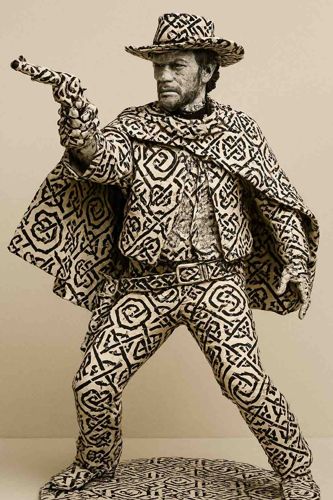
This item is a highly detailed, three-dimensional sculpture depicting a male figure, likely a cowboy or gunslinger, presented in an action pose, holding a firearm in his right hand. The figure is entirely adorned in a distinctive black and white pattern resembling an intricate Celtic knot or labyrinthine design, which covers his hat, face, clothing, and even the pistol he brandishes. The pattern's monochromatic scheme and repetitive interlocking motifs create a striking visual effect, suggesting a possible artistic commentary on identity, perception, or camouflage. The figure wears a wide-brimmed hat, a collared shirt under a cape-like garment, a belted waist, and form-fitting trousers. The folds and drapery of the clothing are well-rendered, showcasing the artist's attention to detail in capturing fabric movement, despite the strong patterning. The facial features of the figure, though partially obscured by the pattern, appear rugged, with visible stubble or a short beard, and a focused, determined expression. The gun in his hand is also fully patterned, blurring the lines between the figure and his weapon, making it seem almost an extension of his patterned body. The sculpture stands on a circular base that shares the same intricate black and white pattern. The overall condition appears to be very good, with no visible signs of damage, wear, or repairs, maintaining a crispness in the patterned detail. The craftsmanship suggests a high level of skill in both sculpting and surface decoration. The style period is difficult to pinpoint without further context, but the artistic approach might lean towards contemporary art, given the stylized patterning and potential conceptual undertones. This unique piece combines realistic figure sculpting with abstract, repetitive surface design, making it a distinctive work.
AI Appraisal Report
Based on my visual examination of the provided image, this Patterned Gunslinger Sculpture appears to be in very good, if not excellent, condition. I detect no visible signs of damage, wear, or repair, and the intricate black and white patterning, which is central to its appeal, seems crisp and intact. The craftsmanship showcased in both the sculptural form and the detailed surface design is of a high caliber, indicating a skilled artist.
The market for unique, well-executed contemporary sculptures, especially those with a distinctive aesthetic like this piece, is generally robust. The combination of realistic figure sculpting with abstract, repetitive surface design makes this piece stand out from typical figurative works. Its uniqueness contributes significantly to its rarity and potential demand among collectors seeking distinctive art. While direct comparables are difficult to pinpoint without knowing the artist, similar high-quality, mid-sized contemporary sculptures by emerging to mid-career artists with a strong concept and execution typically fetch in the range I've estimated. Factors positively impacting value include its striking visual presence, the evident artistic skill, and its excellent apparent condition.
My primary limitation in authentication is that this assessment is based solely on visual inspection of an image. To verify its full authenticity, I would need to conduct an in-person examination to assess the materials (e.g., bronze, resin, ceramic), the weight, and the precise execution of the pattern and form. Provenance documentation, such as artist's signature, date, edition number (if applicable), and purchase history, would be crucial for definitive authentication and to fully understand its market history. Without these, the current appraisal is based purely on observed artistic merit and condition.