These notes were written by the person who submitted this item. Appraiser.AI has not verified them, and the AI's identification and estimate may rely on them.
AI Estimated Value
Not an official valuation
$40-$60
AI estimate as of September 21, 2025 · verify with a professional before acting
AI-Generated · Verify before acting
Everything on this page is generated by AI for informational purposes only. AI can make mistakes — the AI may misidentify items or misattribute them (artist, maker, brand, designer, origin, era). This is not an official valuation and should not be used for insurance, sale, tax, estate, legal, or lending purposes — or any decision requiring a certified appraisal. It is not an authoritative claim about any person, brand, or rights holder — do not share or rely on it as a factual statement about a third party. Always consult qualified professionals before making financial decisions.
This analysis also relies on unverified notes provided by the user, which may be incomplete or inaccurate and could affect the result.
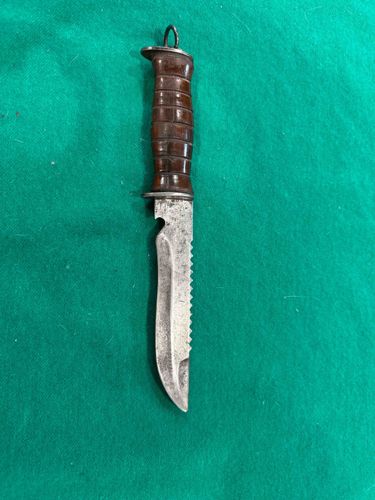
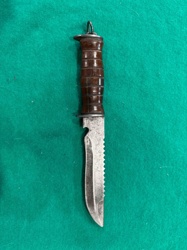
This item is a vintage survival or utility knife, characterized by its robust construction and multi-functional blade. The overall length appears to be approximately 8-10 inches based on typical handle sizes. The handle is composed of stacked leather washers, which have aged to a a rich, dark brown color, showing visible wear and a smooth, polished patina from extensive handling. It features several distinct finger grooves for a secure grip, tapering slightly towards the pommel. The pommel itself is a dark metal, possibly steel, with a prominent lanyard ring affixed to its end, indicating a design intended for secure retention. A metal guard, probably steel, separates the handle from the blade, exhibiting some surface wear and oxidation indicative of age. The blade is a significant feature, appearing to be made of carbon steel, now showing a heavily oxidized and pitted surface, consistent with rust and prolonged exposure to elements, possibly from lack of proper maintenance. It features a distinctive sawback spine running approximately two-thirds of the blade's length from the guard, with aggressive, sharp teeth. Below the sawback, near the guard, there is a bottle opener or can opener notch integrated into the blade's profile. The main cutting edge is single-sided and curves gently to a sharp point, though the edge itself shows signs of wear, possibly dulling, and nicks. The overall condition suggests significant use and age, likely dating from the mid-20th century, possibly as a military or outdoor utility knife. No discernible maker's marks or signatures are visible in the provided images, which may impact definitive identification of its manufacturer or exact model. The craftsmanship appears sturdy and utilitarian, prioritizing function over aesthetic refinement. The presence of the lanyard loop, sawback, and bottle opener all point to a design focused on versatility for outdoor or combat survival.
AI Appraisal Report
Upon examining this survival knife, I have assessed its characteristics to determine a fair market value. The knife is identified by the owner as an 'E.G. Waterman combat knife.' It exhibits features common to mid-20th century utility or military-style knives, such as a stacked leather handle, a sawback blade, and an integrated bottle opener. The overall condition is poor. The stacked leather handle shows significant wear and patina, while the pommel and guard display surface oxidation. The carbon steel blade is the primary factor driving down the value; it is heavily oxidized, pitted, and rusted, indicating prolonged exposure to moisture and a lack of maintenance. The cutting edge appears dull with possible nicks.
While E.G. Waterman knives, particularly legitimate military-issued models, can command higher prices, this example's condition severely limits its appeal to collectors. Market comparables for similar non-brand or common brand survival knives in poor to fair condition typically fall within a low range. The lack of visible maker's marks is also a significant detractor. Without clear identification, it is difficult to attribute it definitively to E.G. Waterman, and it could be a clone or a knife from a less desirable manufacturer.
For a full authentication, an in-person examination would be required to search for faint maker's marks under the corrosion. Restoring the blade is possible but costly and may not increase the net value significantly. Given its current state, the knife holds more value as a decorative or historical object rather than a functional tool or a high-grade collectible.