AI estimate as of July 19, 2025 · verify with a professional before acting
AI-Generated · Verify before acting
Everything on this page is generated by AI for informational purposes only. AI can make mistakes — the AI may misidentify items or misattribute them (artist, maker, brand, designer, origin, era). This is not an official valuation and should not be used for insurance, sale, tax, estate, legal, or lending purposes — or any decision requiring a certified appraisal. It is not an authoritative claim about any person, brand, or rights holder — do not share or rely on it as a factual statement about a third party. Always consult qualified professionals before making financial decisions.
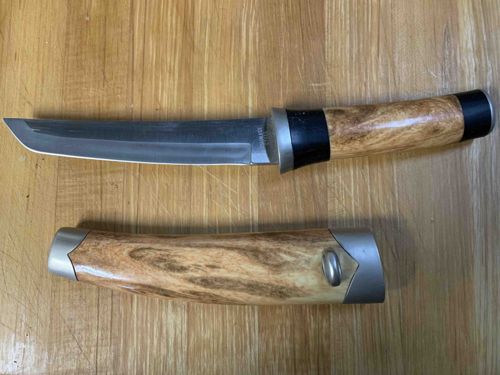
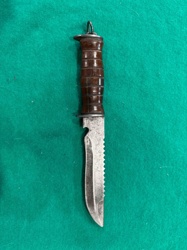
This appears to be a Scandinavian-style fixed-blade knife, often referred to as a Helle knife due to its distinct construction and aesthetic. The blade is a robust, full-tang design with a noticeable scandi grind, characterized by a single, wide bevel that runs from the cutting edge up the blade. The steel has a satin finish with some visible wear and light scratching consistent with use, but no significant rust or pitting. The tip is a straight clip-point or tanto-like profile, designed for piercing and strength. The handle is crafted from what appears to be curly birch or a similar burl wood, exhibiting a rich, undulating grain pattern in shades of light brown and tan. The wood is highly figured, indicating quality material selection. It is ergonomically shaped for a comfortable grip, with an overall smooth and polished surface. The handle is flanked by two distinct bolsters: a prominent, dark (likely black) composite or resin collar near the blade, and a contrasting lighter-toned (likely metal, possibly aluminum or stainless steel) bolster that acts as a guard. This metal bolster also appears at the pommel end, integrated seamlessly with a black end cap, contributing to a balanced aesthetic. The knife is accompanied by a matching sheath, also made from the same beautiful burl wood, with complementary metal fittings at the opening and a small, oval-shaped metal retainer clip on the side, likely for securing the knife. The craftsmanship appears to be high quality, with precise fits between materials and a clean finish throughout, suggesting it is a production knife from a reputable manufacturer, likely from a Nordic country. There are no obvious signs of severe damage, repairs, or excessive wear beyond normal handling.
AI Appraisal Report
Upon examining the provided image of this Scandinavian Fixed Blade Knife, I find it to be a well-crafted example, likely from a reputable Nordic manufacturer such as Helle, based on its distinctive design elements. The scandi grind, full-tang construction, and use of highly figured burl wood (likely curly birch) for the handle are hallmarks of quality and traditional Scandinavian knifemaking. The condition appears to be very good; a satin finish with light wear and scratching is consistent with normal use, but I observe no significant damage, pitting, or rust, suggesting proper care. The matching burl wood sheath with metal fittings further enhances its aesthetic and perceived value.
From a market perspective, Scandinavian knives, particularly those with premium handle materials and matching sheaths, are generally in steady demand among collectors, outdoors enthusiasts, and those appreciating traditional craftsmanship. While not exceptionally rare, the high-quality burl wood and integrated matching sheath elevate it above standard production models. Comparable new knives from reputable makers with similar material quality would typically retail in the $250-$450 range. Second-hand market values for well-maintained examples tend to hold strong, often retaining 60-80% of their original value depending on brand and specific features.
Factors positively impacting value include the excellent apparent condition, the highly figured burl wood, and the rare matching wood sheath, which is an uncommon addition. The integrated bolster and pommel design also suggest a higher-end model. Limitations on authenticity verification from an image alone are significant; while it strongly resembles a Helle or similar quality Scandinavian knife, I cannot definitively confirm the maker without handling it. In-person examination would allow me to check for manufacturer markings (often on the tang or blade heel), assess the precise fit and finish, evaluate blade sharpness and edge integrity, and confirm material authenticity. Provenance documentation or scientific testing of materials would be beneficial for absolute certainty, though from visual cues, it appears genuine and well-made.