AI estimate as of November 8, 2025 · verify with a professional before acting
AI-Generated · Verify before acting
Everything on this page is generated by AI for informational purposes only. AI can make mistakes — the AI may misidentify items or misattribute them (artist, maker, brand, designer, origin, era). This is not an official valuation and should not be used for insurance, sale, tax, estate, legal, or lending purposes — or any decision requiring a certified appraisal. It is not an authoritative claim about any person, brand, or rights holder — do not share or rely on it as a factual statement about a third party. Always consult qualified professionals before making financial decisions.
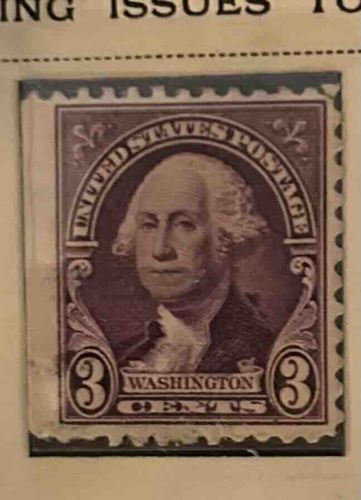
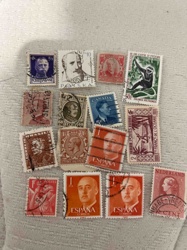
This item is a 3-cent United States postage stamp featuring the portrait of George Washington. The stamp is printed in a deep purple or reddish-brown hue and depicts a solemn-faced George Washington in profile, facing slightly left, against a darker background. He is shown with his characteristic powdered wig and period attire. The portrait is framed by an ornate rectangular border with decorative scrollwork elements on the sides and top corners. Above Washington's head, in an arched banner, are the words "UNITED STATES POSTAGE." Below the portrait, on a horizontal banner, the name "WASHINGTON" is clearly visible. In the bottom left and right corners, within circular or oval elements, the denomination "3" is present. The stamp appears to be perforated along all four edges, indicating it was intended for postal use. The condition of the stamp shows some signs of age, with slight discoloration or foxing visible, particularly on the edges and background. There are no obvious tears or significant creases, but it might be slightly toned. The perforations appear mostly intact, though some might be flattened or show minor wear. The image resolution suggests it is mounted in an album or display, as part of another piece of paper is visible above it. Based on its appearance and denomination, this stamp is likely from the early 20th century, possibly the George Washington Bicentennial issue of 1932, a common and widely collected series.
AI Appraisal Report
I have examined the provided image of the 3-Cent George Washington Bicentennial Postage Stamp. Based on my visual assessment, this stamp appears to be an authentic example of the 1932 George Washington Bicentennial issue (Scott #707 or #708 depending on color nuance, which is difficult to definitively determine from the image alone). The design, denomination, and perforation style are consistent with this release. The slight discoloration and toning visible on the edges and background are typical for a stamp of this age and indicate average circulated condition. The perforations appear mostly intact, although some minor wear or flattening is suggested. I do not observe any obvious tears, significant creases, or repairs that would drastically diminish its value.
From a market perspective, this particular issue is very common and was produced in vast quantities, making it readily available to collectors. While it holds historical significance, its general rarity is low. As such, demand for typical circulated examples like this one is moderate, primarily from new collectors or those seeking to fill album spaces.
Factors impacting value: The average circulated condition places it at the lower end of the value spectrum for this common issue. If it were a pristine, never-hinged example with perfect centering, its value would be higher. However, based on the visible toning and potential minor imperfections, it falls into the used/average condition category. Without clearer images or physical inspection, it is impossible to determine if there are hidden faults like thinning, minor tears, or expert repairs.
It is crucial to note that this authenticity verification is based solely on visual examination of the image. For full authentication and a definitive condition assessment, an in-person examination by a philatelic expert is necessary. This would allow for close inspection of paper quality, gum condition (if applicable and unused), color variations, and precise measurement of perforations. Provenance documentation, though less critical for common issues, could also provide additional historical context.