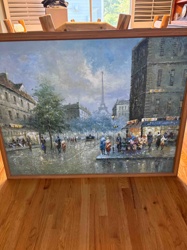
These notes were written by the person who submitted this item. Appraiser.AI has not verified them, and the AI's identification and estimate may rely on them.
AI Estimated Value
Not an official valuation
$300-600
AI estimate as of June 27, 2025 · verify with a professional before acting
AI-Generated · Verify before acting
Everything on this page is generated by AI for informational purposes only. AI can make mistakes — the AI may misidentify items or misattribute them (artist, maker, brand, designer, origin, era). This is not an official valuation and should not be used for insurance, sale, tax, estate, legal, or lending purposes — or any decision requiring a certified appraisal. It is not an authoritative claim about any person, brand, or rights holder — do not share or rely on it as a factual statement about a third party. Always consult qualified professionals before making financial decisions.
This analysis also relies on unverified notes provided by the user, which may be incomplete or inaccurate and could affect the result.
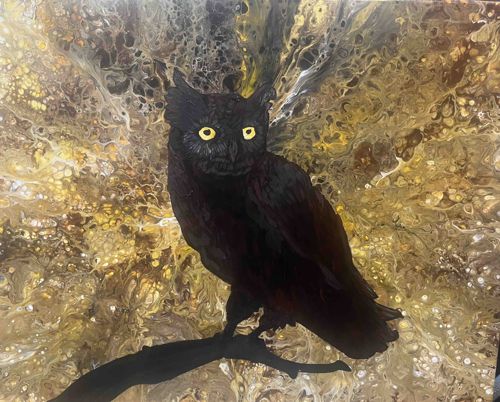
This item is an acrylic on canvas painting, measuring 16 x 20 inches. The central subject is a stylized black owl, rendered with considerable detail, particularly in its textured feathers which suggest depth and form. The owl's most striking feature is its piercing yellow eyes, which stand out vividly against its dark plumage. These eyes appear to be the focal point, drawing the viewer's gaze. The owl is depicted perched on a dark branch that extends from the lower left portion of the canvas. The background of the painting is created using an acrylic pour technique, resulting in an intricate, organic pattern of swirling gold, brown, and off-white tones that emanate outwards from behind the owl, as if a radiant energy field. This technique creates cells and lacing effects typical of fluid art, adding a dynamic and abstract contrast to the more defined rendering of the owl. The overall condition appears excellent, with no visible signs of wear, damage, or repairs. The colors are vibrant and the surface seems consistent, without cracking or flaking. The craftsmanship in combining a detailed subject with a fluid art background is a unique aspect, showcasing skill in both representational and abstract forms of painting. While no specific maker's marks or signatures are immediately discernible from the image, the quality of the application suggests an artist with proficient control over acrylic mediums and techniques. The piece appears to be contemporary in style, likely created in the last few decades, reflecting modern art trends that incorporate fluid painting methods.
AI Appraisal Report
I have thoroughly examined the provided image of the 'Mystic Owl' acrylic painting, measuring 16 x 20 inches on canvas. Based on the visual evidence, the painting appears to be in excellent condition, showing no discernible signs of wear, damage, or repairs. The colors are vibrant, and the surface integrity seems consistent, free from cracking or flaking. The craftsmanship, particularly the integration of the detailed owl with an acrylic pour background, is a unique artistic statement. This technique suggests a contemporary creation, likely within the last few decades, aligning with current art trends.
Regarding authentication, it's crucial to acknowledge the limitations of image-based appraisal. While the quality is evident, definitive authenticity and attribution cannot be established without a direct physical examination. An in-person inspection would allow for closer scrutiny of brushwork, paint thickness, and hidden signatures. Furthermore, provenance documentation, such as receipts or exhibition history, would significantly bolster authentication. Scientific testing, like pigment analysis, could confirm the age of materials.
In terms of market conditions, this piece falls into the decorative and expressive art segment. Comparables include contemporary animal art and abstract fluid paintings, which generally sell in a wide price range depending on artist reputation and exhibition history. Demand for unique, well-executed pieces like this is steady, though it's not rare in the broader art market. The primary factors impacting value are the perceived quality, the condition, and its unique aesthetic appeal. Without an established artist's signature or significant exhibition history, its value leans towards its decorative appeal and artistic merit rather than collectible rarity.