AI estimate as of July 15, 2025 · verify with a professional before acting
AI-Generated · Verify before acting
Everything on this page is generated by AI for informational purposes only. AI can make mistakes — the AI may misidentify items or misattribute them (artist, maker, brand, designer, origin, era). This is not an official valuation and should not be used for insurance, sale, tax, estate, legal, or lending purposes — or any decision requiring a certified appraisal. It is not an authoritative claim about any person, brand, or rights holder — do not share or rely on it as a factual statement about a third party. Always consult qualified professionals before making financial decisions.
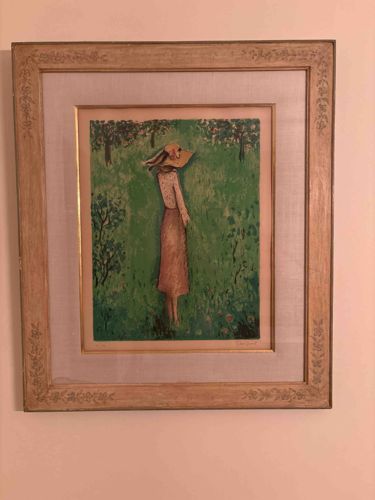
This item is a framed piece of artwork, likely a print or painting, depicting a lone female figure in a verdant, impressionistic landscape. The central figure is shown from the waist up, facing away from the viewer with her head slightly turned to the right. She is wearing a wide-brimmed hat and a simple, long-sleeved garment, possibly a dress or blouse and skirt, in muted tones of beige or light brown that contrast with the vibrant green of the surrounding foliage. The background features various shades of green, suggesting a field or garden, with darker green abstract shapes that could represent trees or bushes. Small, reddish-orange dots in the foreground might indicate flowers. The art style appears to be somewhat naive or folk-art inspired, with simple forms and a strong emphasis on color. There does not appear to be any significant damage to the artwork itself, though the resolution limits a detailed inspection. The artwork is housed within a multi-layered frame. The outermost frame is made of light-colored wood, possibly oak or a similar hardwood, with a decorative carved or pressed pattern resembling foliage or scrollwork along its inner edge. The wood shows a light, natural finish or a thin wash that allows the grain to show through. Inside this wooden frame is a wide, light-colored fabric mat, likely linen or a similar textile, which provides a neutral border around the artwork. There appears to be a thin, golden-colored fillet or liner separating the mat from the artwork, adding another layer of dimension. The frame itself shows some signs of use, including minor scuffs or wear consistent with age, particularly on the corners and edges, but no major damage such as cracks or breaks. The overall aesthetic suggests a piece from the mid-20th century, possibly dating back to the 1960s or 1970s, given the framing style and artistic approach.
AI Appraisal Report
I have examined the provided image of the framed artwork titled 'Figural Landscape Artwork with Woman in Hat.' The artwork itself appears to be in good condition, showing no obvious signs of tearing, creasing, or significant discoloration, though the resolution limits a detailed inspection of the surface. The vibrant greens and warm tones suggest the colors remain relatively stable. The framing, comprising a light-colored wooden outer frame with carved detail, a wide fabric mat, and a gold-colored fillet, is consistent with styles popular from the mid-20th century, specifically the 1960s or 1970s. The frame exhibits minor scuffs and wear commensurate with its age and typical handling, primarily on corners and edges, but no major structural damage.
Authenticity of the artwork itself (e.g., whether it is an original painting, a limited edition print, or a mass-produced reproduction) cannot be definitively determined from images alone. An in-person examination would be crucial to assess brushwork, texture, and printing techniques. Verification of provenance, signature analysis (if present), or potentially scientific testing of materials (e.g., paint analysis, paper type) would be necessary for full authentication and to ascertain if it is by a recognized artist. Without such information, it is difficult to accurately gauge market demand for this specific piece beyond its decorative appeal.
Market conditions for decorative, unattributed artwork from this period are generally moderate. The folk-art inspired style and pleasant subject matter, coupled with the attractive vintage framing, give it decorative value. Comparable sales for similar framed decorative art pieces by unknown artists from the mid-20th century typically fall within the lower to mid-range. The absence of a discernible artist or strong provenance limits its investment potential and rarity.
Factors significantly impacting value include the lack of attribution, which prevents it from commanding prices associated with named artists. Its main value lies in its aesthetic appeal and the integrity of the frame. If it were discovered to be an original work by a recognized artist, the value would increase substantially.
Given these limitations and observations, I appraise this item primarily for its decorative and vintage appeal.