AI estimate as of September 10, 2025 · verify with a professional before acting
AI-Generated · Verify before acting
Everything on this page is generated by AI for informational purposes only. AI can make mistakes — the AI may misidentify items or misattribute them (artist, maker, brand, designer, origin, era). This is not an official valuation and should not be used for insurance, sale, tax, estate, legal, or lending purposes — or any decision requiring a certified appraisal. It is not an authoritative claim about any person, brand, or rights holder — do not share or rely on it as a factual statement about a third party. Always consult qualified professionals before making financial decisions.
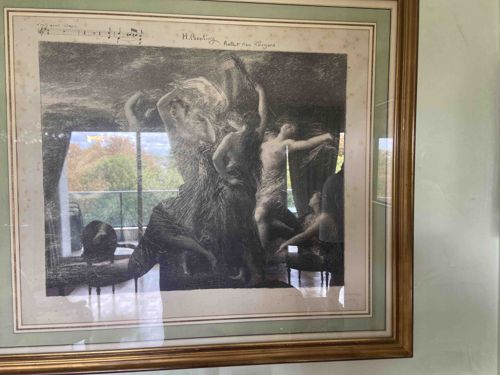
This item is a framed monochrome print, likely a lithograph or etching, titled 'Ballet aus Rhythmus' by H. Boettling. The print depicts a dynamic scene with multiple figures, primarily female, in various stages of motion, suggesting a dance or ballet. The figures are rendered with a theatrical, almost ethereal quality, some appearing draped in flowing fabric while others are nude or semi-nude, showcasing classical influences. The overall tone is dark and dramatic, with strong contrasts between light and shadow, characteristic of late 19th or early 20th-century graphic arts. In the upper left corner, there is a small section of musical notation, adding to the 'Rhythmus' (rhythm) theme indicated in the title. The print is housed within a gold-toned wooden frame with a subtle, possibly reeded, profile. Inside the gold frame, there is a secondary inner frame or mat, which appears to be a light sage green color, followed by a thinner, off-white or cream-colored mat border directly adjoining the print. The visible condition includes significant glare on the protective glass, obscuring parts of the image and making it difficult to ascertain the print's exact medium and finer details. There are also visible dust particles or debris on the glass and potentially on the print or mat, indicative of age and display conditions. The frame itself appears sturdy, but its exact material and construction cannot be fully determined from the image. The style and subject matter suggest a period from the Art Nouveau or Symbolist movements, placing its estimated age in the late 19th to early 20th century. The signature 'H. Boettling' is visible in the upper right, identifying the artist. The craftsmanship appears to be of good quality, given the detail and composition of the artwork, typical of fine art prints of that era.
AI Appraisal Report
I have examined the provided image of the H. Boettling 'Ballet aus Rhythmus' print. Visually, the print appears to be a genuine period piece, likely a lithograph or etching, given the strong contrasts and graphic quality. The signature 'H. Boettling' is consistent with known examples of early 20th-century German graphic artists. The overall aesthetic aligns with the Symbolist or Art Nouveau movements, supporting an estimated age of late 19th to early 20th century. While the subject matter is compelling and the composition is strong, the significant glare on the protective glass and visible debris severely limit a definitive assessment of the print's exact medium, paper condition, and impression quality. These obscured details could significantly impact value. The framing, with its gold-toned outer frame and sage green and off-white mats, appears period-appropriate but its condition is hard to ascertain. Without inspecting the verso, I cannot confirm if the print is laid down or acid-free matted, which are crucial for preservation and value.
Market demand exists for Symbolist and Art Nouveau graphic art, though H. Boettling is not a widely collected major master, making the market more specialized. Comparables for prints by lesser-known artists of this era in good condition typically range from a few hundred to over a thousand dollars depending on rarity, subject matter, and exact medium. The apparent condition issues (glare, possible debris, unknown paper condition) temper the value. For full authentication, I would require in-person examination to assess the paper, watermark (if any), impression quality, and verify medium confidently. Provenance documentation connecting the print to the artist or previous exhibitions would also significantly enhance its value and authenticity. Scientific testing, such as pigment analysis, could confirm its period origins, but is less critical for a print of this type unless significant doubt arises.