AI estimate as of October 10, 2025 · verify with a professional before acting
AI-Generated · Verify before acting
Everything on this page is generated by AI for informational purposes only. AI can make mistakes — the AI may misidentify items or misattribute them (artist, maker, brand, designer, origin, era). This is not an official valuation and should not be used for insurance, sale, tax, estate, legal, or lending purposes — or any decision requiring a certified appraisal. It is not an authoritative claim about any person, brand, or rights holder — do not share or rely on it as a factual statement about a third party. Always consult qualified professionals before making financial decisions.
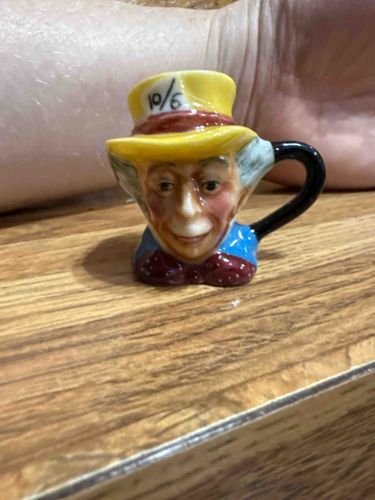
This item is a small, ceramic or porcelain character teacup or miniature mug, sculpted and painted to resemble the Mad Hatter from Lewis Carroll's 'Alice's Adventures in Wonderland'. The piece features the Mad Hatter's distinct facial features, including rosy cheeks, a prominent nose, and a slight smile, framed by white or grey sculpted hair that appears to extend from either side of his face. He is depicted wearing a blue jacket collar with white accents and a red bowtie, which is spotted with white dots. The most iconic element, his oversized yellow top hat, is prominently featured, complete with a dark red band and a printed tag displaying '10/6', a well-known detail from the original story. The hat forms the upper rim of the cup. A black, C-shaped handle is attached to the right side of the character's head, suggesting its function as a mug or teacup, albeit a very small one, likely for decorative purposes, collecting, or perhaps a thimble. The glaze appears glossy and even, indicating a mass-produced item rather than a hand-painted artisan piece, though the painting detail is quite good for a collectible. There are no visible chips, cracks, or significant wear on the piece, suggesting it is in very good to excellent condition. The colors are vibrant and well-preserved. Given its character depiction and likely production style, it probably belongs to a series of Alice in Wonderland collectibles from the mid-to-late 20th century or early 21st century. The craftsmanship is decent, with clear molded features and hand-painted details.
AI Appraisal Report
I have carefully examined the provided image of this Mad Hatter character teacup or miniature mug. Visually, the piece appears to be in very good to excellent condition, showing no apparent chips, cracks, or significant wear. The colors are vibrant and well-preserved, suggesting careful handling or recent production. The sculpted details are clear, and the hand-painted elements, such as the facial features and the '10/6' tag, are executed with decent precision for a mass-produced collectible.
This item, by its design as a character teacup, falls into the category of collectible ceramic novelties, likely appealing to 'Alice's Adventures in Wonderland' enthusiasts or collectors of character memorabilia. Given its glossy glaze and molded features, it is almost certainly a mass-produced item. While the craftsmanship is good for its type, it does not suggest a high-end artisan piece, which typically commands higher values. Similar character-themed miniature mugs or teacups, often from various collectible series by companies like Disney, usually retail in the low to mid-range for collectibles.
The potential market for such an item is primarily collectors. While 'Alice in Wonderland' is universally popular, the specific demand for this type of miniature mug is moderate. Its rarity is likely low to moderate, depending on the specific manufacturer and production run. Factors impacting value include its excellent condition and the iconic character representation. However, being a mass-produced item limits its upper value potential.
Without physical examination, I cannot definitively confirm the material (ceramic vs. porcelain), the exact age, or the manufacturer. While the visual indicators suggest good condition, an in-person inspection would allow for a thorough check for hairline cracks, minor paint loss, or manufacturing flaws not visible in the image. Provenance documentation or manufacturer's marks on the base would also be crucial for full authentication and precise dating, which could influence its value within a specific series.