AI estimate as of August 27, 2025 · verify with a professional before acting
AI-Generated · Verify before acting
Everything on this page is generated by AI for informational purposes only. AI can make mistakes — the AI may misidentify items or misattribute them (artist, maker, brand, designer, origin, era). This is not an official valuation and should not be used for insurance, sale, tax, estate, legal, or lending purposes — or any decision requiring a certified appraisal. It is not an authoritative claim about any person, brand, or rights holder — do not share or rely on it as a factual statement about a third party. Always consult qualified professionals before making financial decisions.
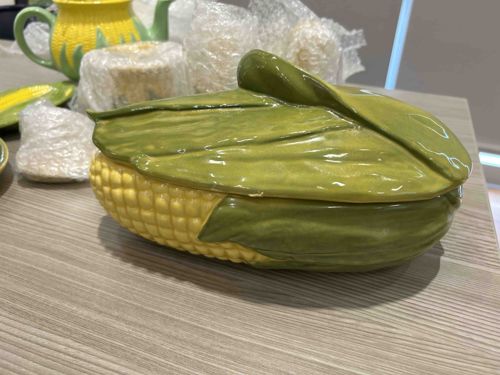
This item is a ceramic lidded dish, intricately designed to resemble an ear of corn. It features a vibrant color palette, with the main body of the dish being a bright yellow, textured to mimic individual corn kernels. The lid, which forms the top half of the corn cob, is a glossy, light green, sculpted to represent corn husks, complete with raised veins and folds to enhance its naturalistic appearance. The ceramic material has a high-gloss glaze across both the yellow kernel portion and the green husk lid, giving it a smooth, reflective finish. There are no visible chips, cracks, or significant wear on the surface, suggesting it is in good to excellent condition. The item appears to be mass-produced, likely from the late 20th century or early 21st century, judging by its detailed yet uniform craftsmanship and the style often associated with novelty kitchenware from that period. There are no discernible maker's marks or signatures visible in the provided image. The construction appears to be solid and well-crafted, with a snug fit between the lid and the base, indicating a good quality molding process.
AI Appraisal Report
Upon visual examination of the provided image, I assess this Ceramic Corn on the Cob Lidded Dish to be in excellent condition. The high-gloss glaze is intact, and there are no apparent chips, cracks, or significant wear. This suggests careful handling and storage. Authenticity, based solely on the image, points to a mass-produced item. The uniform craftsmanship and detailed yet stylized design are consistent with novelty kitchenware from the late 20th or early 21st century. The absence of maker's marks is common for such items and does not negatively impact my assessment within this category, though in-person examination could reveal hidden marks.
Market conditions for novelty ceramic kitchenware, even in excellent condition, are generally modest. Comparables often include similar lidded dishes, butter dishes, or serving pieces resembling fruits, vegetables, or animals. Demand is niche; while charming, these items are typically sought after by collectors of specific kitchen kitsch or those furnishing retro-themed spaces, rather than by fine art or antique collectors. Rarity is low, as mass production indicates numerous examples exist.
The primary factors impacting value are the excellent condition, the whimsical design, and its functionality. However, the lack of a known manufacturer, significant artistic merit, or historical provenance limits its value. Without physical inspection, I cannot confirm the exact weight, feel of the ceramic, or the precise snugness of the lid, which could slightly influence perceived quality. To fully authenticate, I would seek any hidden manufacturer's marks or original packaging, though these are unlikely to dramatically alter the appraisal for this type of item.