AI Appraisal Estimate

AI-generated estimates · not official valuations

From the user

What was submitted

Photo and notes provided by the user — not generated by AI

Submitted item photo
Submitted photo · May 28, 2026

User's notes

No additional notes provided.

AI analysis below

AI appraisal

AI analysis & estimate

AI-Generated · Verify before acting

Everything below is generated by AI for informational purposes only. AI can make mistakes — the AI may misidentify items or misattribute them (artist, maker, brand, designer, origin, era). This is not an official valuation and should not be used for insurance, sale, tax, estate, legal, or lending purposes — or any decision requiring a certified appraisal. It is not an authoritative claim about any person, brand, or rights holder — do not share or rely on it as a factual statement about a third party. Always consult qualified professionals before making financial decisions.

Read the full disclaimer

AI Identification

·Not independently authenticated·Verify before acting

Antique French Ceramic Mustard Pot (Moutarde Racquet Yvetot)

Ceramic Tableware

AI Estimated Value

·Not an official valuation·Verify before acting

$150-250

As of May 28, 2026

AI Item Analysis

·AI can make mistakes·Verify before acting
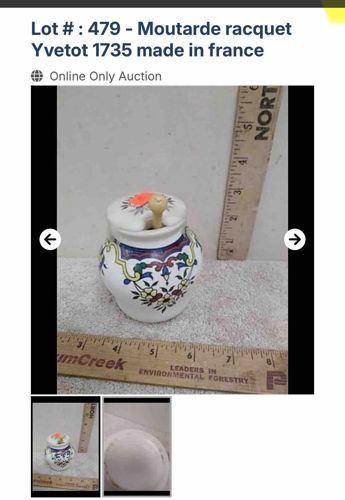
The item appears to be a small, ceramic mustard pot with a lid and an integrated serving spoon or dipper. It has a rounded, squat body that tapers slightly towards the rim, indicating a classic functional design for a condiment vessel. The dominant color is a creamy white, serving as a clean background for an intricate polychrome floral and ornamental pattern that wraps around its circumference. The decoration includes stylized flowers in shades of yellow, red/orange, and green, interspersed with blue and green scrollwork or foliage. A prominent design element on the body features a dark blue, almost indigo, arched border with red and yellow accents. The lid is also white with a matching floral motif and has a circular opening to accommodate the spoon, which appears to be made of a light-colored, possibly bone or ivory-toned material, contrasting with the ceramic. The spoon has a distinctive knob-like handle for easy gripping. Visually, there are no glaring condition issues such as cracks, chips, or significant wear visible from the provided angle, suggesting it is in good to very good condition. The craftsmanship appears to be a hand-painted style, given the slight variations in the motifs, which adds to its uniqueness. Based on the accompanying text, it is identified as 'Moutarde racquet Yvetot 1735 made in france,' implying a French origin and a potential manufacturing date of 1735, which would classify it as an antique. The term 'Yvetot' likely refers to a region or pottery center known for this style. The presence of a ruler in the background suggests its size is approximately 4-5 inches in height, fitting for a tabletop condiment server.
AI Appraisal Report

·AI can make mistakes·Verify before acting
Upon visual examination of this ceramic mustard pot, identified as 'Moutarde Racquet Yvetot 1735', I note its charming hand-painted design and overall excellent condition for its purported age. The piece features a polychrome floral and scrollwork decoration typical of French faience from the 18th and 19th centuries. Visually, there are no discernible cracks, major chips, or repairs, and the glaze appears intact, which is a significant value-positive factor. The integrated spoon, a frequent point of loss or damage, appears to be present and in good condition. The stated date of '1735' is a critical factor. If authentic to this period, the item is exceptionally rare and valuable. However, many ceramics marked with historical dates are revival pieces or reproductions made in the late 19th or early 20th century in the style of earlier periods. Yvetot was not a major faience center on par with Rouen or Nevers, making a 1735 piece from this specific location less documented and harder to verify without expert comparison. My valuation is based on similar, attributed French faience mustard pots from the late 19th-century revival period, which this piece more closely resembles in style and condition. An authentic 1735 piece would be valued significantly higher. Limitation: Authentication from images alone is impossible. To confirm the '1735' date, a physical examination is required to assess the paste, weight, glaze texture, and maker's marks on the underside. Thermoluminescence testing could provide a more definitive age range. Without such verification or provenance documentation, I must appraise it as a high-quality, late 19th-century antique in the 18th-century style.

Get your items appraised

Instant estimates of your treasures with AI-powered appraisals

Browse More Appraisals