These notes were written by the person who submitted this item. Appraiser.AI has not verified them, and the AI's identification and estimate may rely on them.
AI Estimated Value
Not an official valuation
$5 - $15
AI estimate as of November 10, 2025 · verify with a professional before acting
AI-Generated · Verify before acting
Everything on this page is generated by AI for informational purposes only. AI can make mistakes — the AI may misidentify items or misattribute them (artist, maker, brand, designer, origin, era). This is not an official valuation and should not be used for insurance, sale, tax, estate, legal, or lending purposes — or any decision requiring a certified appraisal. It is not an authoritative claim about any person, brand, or rights holder — do not share or rely on it as a factual statement about a third party. Always consult qualified professionals before making financial decisions.
This analysis also relies on unverified notes provided by the user, which may be incomplete or inaccurate and could affect the result.
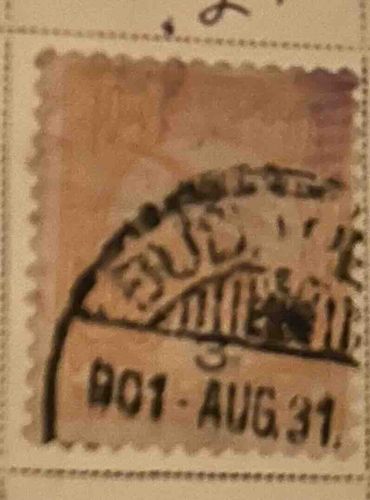
The item is a philatelic specimen, specifically a postage stamp, characterized by its rectangular shape and perforated edges. The primary color of the stamp appears to be a muted reddish-brown or sepia, indicating an older print or potentially fading due to age and exposure. A prominent, partial circular postmark in black ink covers a significant portion of the stamp's lower half and extends into the upper design elements. The postmark's design is intricate, suggesting a detailed cancellation device. Crucially, the legible part of the postmark clearly displays '901 - AUG 31.', strongly suggesting a date of August 31, 1901. Above this date, within the circular postmark, there appear to be indecipherable letters or numbers, likely indicating the issuing post office or a specific code. The design printed on the stamp itself, underneath the postmark, is difficult to ascertain fully due to the obscuring cancellation and the overall soft focus of the image, but it appears to be an allegorical figure or a national emblem, typical of postage stamps from the late 19th or early 20th century. The stamp exhibits visible signs of age including slight fading of the stamp's base color and the general wear associated with a used postal item. The perforations around the edges seem relatively intact, although their exact condition (e.g., whether any are short or torn) cannot be definitively determined from the image provided. There are no obvious tears, significant creases, or repairs visible, though a more detailed examination would be needed to confirm its precise condition. The presence of the clear postmark with a date is a key characteristic, indicating it is a used stamp.
AI Appraisal Report
Upon examining the provided image of the Hungarian postage stamp, I assess its condition as 'used' with a clear partial circular postmark dated '901 - AUG 31'. The stamp exhibits typical signs of age, including a muted reddish-brown color, which could be its original shade or due to fading. The perforations appear largely intact, though a precise assessment for short or torn perforations would require a physical examination. No significant tears, creases, or repairs are evident from the image, suggesting a relatively good state for a stamp of this age. The postmark itself, while clear, partially obscures the underlying design, which seems to be an allegorical figure or national emblem characteristic of early 20th-century Hungarian issues.
From the visual evidence, the stamp's authenticity as a genuine Hungarian postage stamp from around 1901 is highly probable, especially given the clear postmark date. However, definitive authentication would necessitate an in-person examination to confirm plate varieties, paper type, watermark, and print details that are critical for identifying specific issues and potential forgeries. Provenance documentation, though helpful, is not usually available for common stamps.
Regarding market conditions, demand, and rarity, Hungarian stamps from this era are generally common unless they are rare specific varieties, high values, or errors. The postmark, while legible, does not appear to be a rare cancellation. Without knowing the specific design (which is currently obscured), it's challenging to pinpoint an exact catalog number. However, based on the typical value of common Hungarian issues from 1901 in used condition, these generally fall within a modest range. The clear, dated postmark adds some appeal but does not elevate it into a rare category. The main limiting factor for valuation from the image is the incomplete visibility of the stamp's design and the inability to assess the exact variety or any hidden defects.