AI estimate as of August 8, 2025 · verify with a professional before acting
AI-Generated · Verify before acting
Everything on this page is generated by AI for informational purposes only. AI can make mistakes — the AI may misidentify items or misattribute them (artist, maker, brand, designer, origin, era). This is not an official valuation and should not be used for insurance, sale, tax, estate, legal, or lending purposes — or any decision requiring a certified appraisal. It is not an authoritative claim about any person, brand, or rights holder — do not share or rely on it as a factual statement about a third party. Always consult qualified professionals before making financial decisions.
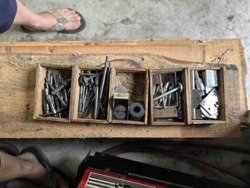
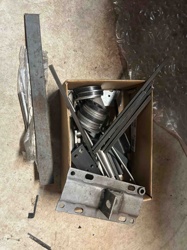
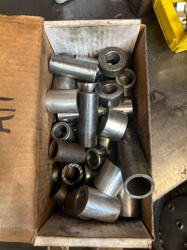
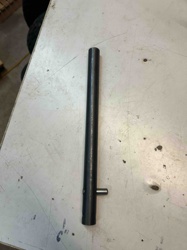
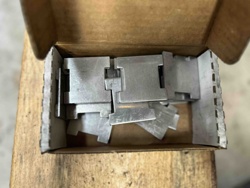
The image displays a collection of flat, metallic components, likely made from aluminum or a similar light-colored alloy, contained within a brown cardboard box. These pieces appear to be precision-cut shims or spacing plates, characterized by their thin profile and geometric shapes. Many of the visible pieces are rectangular with various notches or cutouts on their edges or interior, suggesting they are designed to fit around or between other components. The surfaces exhibit a matte, somewhat dull metallic finish, indicative of standard industrial production rather than highly polished decorative items. Some pieces show slight variations in color or surface texture, possibly due to minor handling marks or differences in their specific alloy composition or surface treatment. There are no obvious signs of significant wear, corrosion, or damage such as bending or deep scratches, suggesting they are either new stock or have seen minimal use. The edges appear clean and precisely cut, indicating a manufacturing process like stamping, laser cutting, or waterjet cutting. The uniformity in general appearance suggests they are part of a batch of identical or very similar components, likely intended for assembly or alignment purposes in machinery or construction. No discernible manufacturer markings, part numbers, or branding are visible on any of the individual pieces or the box itself. Given their appearance, they are likely modern industrial parts, probably dating from the late 20th to early 21st century.
AI Appraisal Report
Based on my visual examination of the provided image, I assess this lot of assorted metal shims/spacing plates. The components appear to be in excellent, unused condition, exhibiting clean, precision-cut edges and a uniform matte metallic finish. There are no visible signs of wear, corrosion, bending, or significant scratches, suggesting they are either new stock or have seen minimal handling. Authenticity for such generic industrial components is less about forgery and more about material specification; from the image alone, I can confirm they appear to be standard, industrial-grade components. However, I cannot definitively determine the exact alloy composition (e.g., specific aluminum grade, steel, brass) or precise dimensional tolerances, which are critical for their intended application and exact market value. Precise material verification would require in-person visual inspection, spectrometric testing (XRF), or review of manufacturer's specifications/certifications. Dimensional verification would require precise measurement tools.
In terms of market conditions, these are essentially commodity industrial fasteners/spacing components. Demand is consistent within manufacturing, machinery repair, and custom fabrication sectors. Rarity is low as similar components are mass-produced by numerous suppliers. The value is primarily driven by material cost, manufacturing precision, and quantity. Without knowing the exact number of pieces, specific dimensions, and precise material, a definitive value is challenging. However, based on the apparent quantity and typical pricing for such precision-cut shims, my valuation assumes standard aluminum or mild steel construction. Significant factors impacting value would be if they are made from specialized alloys (e.g., stainless steel, titanium), or are part of a certified aerospace or medical-grade batch, which is impossible to ascertain from the image.
Purchasing these new in small quantities directly from a specialty supplier would typically fetch a higher per-piece price due to packaging and handling. Conversely, a large bulk purchase or surplus lot would have a lower unit cost. This appears to be a smaller quantity lot.