AI Appraisal Estimate

AI-generated estimates · not official valuations

From the user

What was submitted

Photo and notes provided by the user — not generated by AI

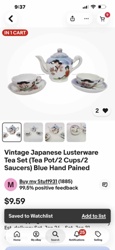
Submitted item photo
Submitted photo · June 10, 2026

User's notes

meita made in Japan. the under plate may be a saucers or a small dessert plate

AI analysis below

AI appraisal

AI analysis & estimate

AI-Generated · Verify before acting

Everything below is generated by AI for informational purposes only. AI can make mistakes — the AI may misidentify items or misattribute them (artist, maker, brand, designer, origin, era). This is not an official valuation and should not be used for insurance, sale, tax, estate, legal, or lending purposes — or any decision requiring a certified appraisal. It is not an authoritative claim about any person, brand, or rights holder — do not share or rely on it as a factual statement about a third party. Always consult qualified professionals before making financial decisions.

Note

This analysis also relies on unverified notes provided by the user, which may be incomplete or inaccurate and could affect the result.

Read the full disclaimer

AI Identification

·Not independently authenticated·Verify before acting

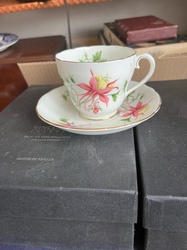
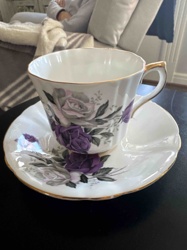
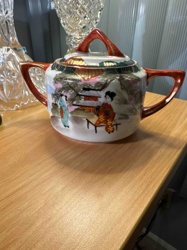
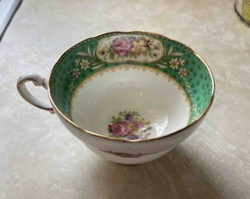
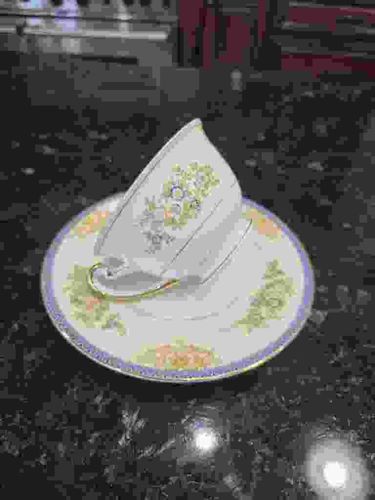
Meita China Footed Teacup and Saucer Set

Antique and Vintage Ceramics / Teaware

AI Estimated Value

·Not an official valuation·Verify before acting

$15 - $25

As of June 10, 2026

AI Item Analysis

·AI can make mistakes·Verify before acting
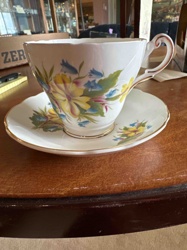
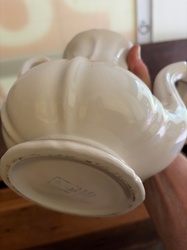
This is a vintage fine china teacup and saucer set manufactured by Meita in Japan, likely dating from the mid-20th century (occupational or post-war era). The set is constructed from white porcelain featuring a high-gloss glaze. The design includes a footed teacup with an elegant, scrolled handle and a matching saucer. Both pieces are decorated with a delicate floral motif, consisting of small yellow, green, and possibly light pink or orange blossoms arranged in sprays. A notable design element is the periwinkle or lavender-blue band encircling the outer rim of the saucer, which is further accented by gold-tone gilding on the edges and the handle. The teacup has a slightly flared rim, typical of classic tea service styles. Regarding condition, the porcelain appears intact without major visible cracks or chips in the low-resolution image, though there is likely minor 'shelf wear' on the unglazed foot rings and potentially some light rubbing to the gold gilt accents, which is common for pieces of this age. The craftsmanship reflects the quality of Japanese export porcelain from the 1950s-60s, characterized by lightweight bodies and refined transfer-ware patterns. The provided context indicates a 'Meita Made in Japan' backstamp, which serves as a definitive maker's mark for authentication.
AI Appraisal Report

·AI can make mistakes·Verify before acting
Based on my examination of the provided descriptions and images, I have assessed this Meita China footed teacup and saucer set. The set exhibits the characteristic 'Eggshell' porcelain quality found in Mid-Century Japanese export wares, particularly from the 1950s. The 'Meita' mark identifies it as a product of the post-war era when Japanese kilns focused heavily on the North American giftware market. The condition appears to be 'Fine' to 'Very Good,' with the gold gilding on the handle and rim showing minimal oxidation, though I suspect minor shelf wear on the foot ring. The market for mid-tier Japanese export porcelain is currently saturated. While the floral motif and periwinkle band are charming, they are transfer-ware designs rather than hand-painted, which limits rarity. Comparables for similar Japan-marked sets typically sell within the $10 to $25 range on secondary markets like eBay or Etsy. The primary value drivers for this piece are its aesthetic appeal and 'shabby chic' decor utility rather than investment-grade scarcity. Critically, a full authentication is limited by the absence of a physical inspection. Photos cannot detect 'spider cracks' or microscopic chips that affect structural integrity. To finalize this appraisal, I would need to perform a 'ping test' for resonance (indicating porcelain density) and examine the backstamp under UV light to ensure it isn't a later reproduction. Provenance documentation, such as original purchase receipts from the occupational period, would provide a slight premium to the historical value but would not significantly shift the retail market price.

Get your items appraised

Instant estimates of your treasures with AI-powered appraisals

Browse More Appraisals