AI Appraisal Estimate

AI-generated estimates · not official valuations

From the user

What was submitted

Photo and notes provided by the user — not generated by AI

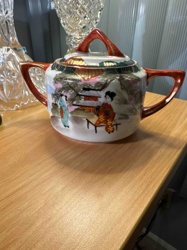
Submitted item photo
Submitted photo · June 8, 2026

User's notes

Chinoiserie-style porcelain teapot

AI analysis below

AI appraisal

AI analysis & estimate

AI-Generated · Verify before acting

Everything below is generated by AI for informational purposes only. AI can make mistakes — the AI may misidentify items or misattribute them (artist, maker, brand, designer, origin, era). This is not an official valuation and should not be used for insurance, sale, tax, estate, legal, or lending purposes — or any decision requiring a certified appraisal. It is not an authoritative claim about any person, brand, or rights holder — do not share or rely on it as a factual statement about a third party. Always consult qualified professionals before making financial decisions.

Note

This analysis also relies on unverified notes provided by the user, which may be incomplete or inaccurate and could affect the result.

Read the full disclaimer

AI Identification

·Not independently authenticated·Verify before acting

Blue and White Chinoiserie Porcelain Teapot with Faux-Bamboo Handle and Spout

Antique and Vintage Ceramics / Teaware

AI Estimated Value

·Not an official valuation·Verify before acting

$175 - $250

As of June 8, 2026

AI Item Analysis

·AI can make mistakes·Verify before acting
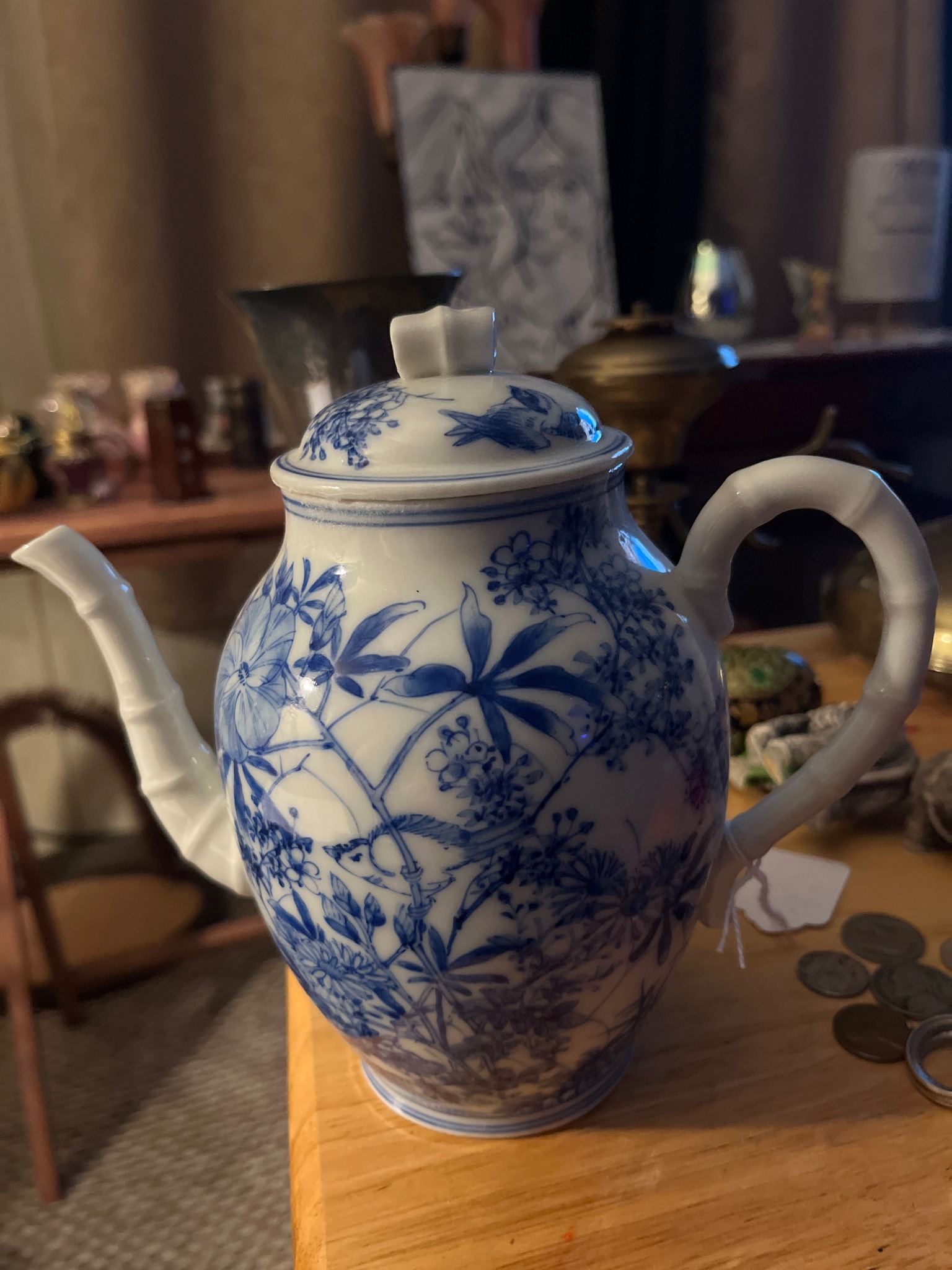
This is a fine-bodied porcelain teapot featuring a classic Chinoiserie aesthetic, likely produced in the late 19th to mid-20th century. The vessel is decorated with underglaze cobalt blue transfer or hand-finished motifs depicting a lush botanical scene with perching birds, blossoms, and intricate foliage. A distinctive feature is the slip-cast 'faux-bamboo' modeling seen on the spout and the large C-scroll handle, adding a tactile, naturalist element typical of East Asian influence in Western ceramics. The lid is domed with a matching floral motif and topped with a stylized knot or blossom finial. Physically, the porcelain exhibits a bright white ground with a high-gloss glaze. The construction shows a pear-shaped body tapering to a narrow, ringed base. Regarding condition, the glaze appears well-preserved with typical minor surface wear; there is a visible accumulation of dust or residue along the inner rim of the lid. No major cracks or restorations are immediately apparent, though internal staining from use is common in pieces of this age. The craftsmanship is of good quality, shown through the alignment of the transfer patterns and the anatomical precision of the bamboo-style molding.
AI Appraisal Report

·AI can make mistakes·Verify before acting
I have carefully examined the provided images and descriptions of this blue and white porcelain teapot. The 'faux-bamboo' modeling on the handle and spout indicates a 19th-century Aesthetic Movement influence, a style popularized by manufacturers like Minton or Copeland, though this appears to be a high-quality Continental or English export piece from the late Victorian to early Edwardian era (circa 1890–1920). The cobalt underglaze is crisp, and the slip-cast bamboo elements show excellent definition, suggesting a mold of high integrity. Condition-wise, the glaze retains a high-gloss luster. The visible residue along the lid rim is negligible in value assessment as it can be professionally cleaned, provided there are no underlying 'flea bites' or chips. The market for Chinoiserie remains stable, driven by the 'Grandmillennial' interior design trend. However, mass-produced transferware from this era is relatively common, which limits the ceiling price compared to hand-painted 18th-century porcelain. Critically, a definitive valuation is limited by the lack of a visible maker’s mark or backstamp. My appraisal assumes the piece is free of hairline fractures and structural repairs, which are often invisible in photographs. To fully authenticate this item, a physical inspection is required to check for 'ring' resonance (acoustic testing for cracks), UV light examination to detect overpainting, and a macro-inspection of the foot rim to verify the paste type (soft-paste vs. hard-paste). Provenance documentation regarding its original purchase or family history would further enhance its marketability.

Get your items appraised

Instant estimates of your treasures with AI-powered appraisals

Browse More Appraisals