AI Appraisal Estimate

AI-generated estimates · not official valuations

From the user

What was submitted

Photo and notes provided by the user — not generated by AI

Submitted item photo
Submitted photo · June 10, 2026

User's notes

No additional notes provided.

AI analysis below

AI appraisal

AI analysis & estimate

AI-Generated · Verify before acting

Everything below is generated by AI for informational purposes only. AI can make mistakes — the AI may misidentify items or misattribute them (artist, maker, brand, designer, origin, era). This is not an official valuation and should not be used for insurance, sale, tax, estate, legal, or lending purposes — or any decision requiring a certified appraisal. It is not an authoritative claim about any person, brand, or rights holder — do not share or rely on it as a factual statement about a third party. Always consult qualified professionals before making financial decisions.

Read the full disclaimer

AI Identification

·Not independently authenticated·Verify before acting

Art Deco Hand-Painted Ceramic Creamer and Pitcher Set

Antiques & Collectibles - Pottery & Ceramics

AI Estimated Value

·Not an official valuation·Verify before acting

$60 - $120

As of June 10, 2026

AI Item Analysis

·AI can make mistakes·Verify before acting
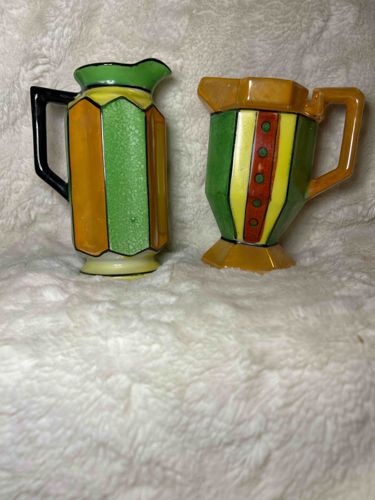
This pair of ceramics consists of a tall faceted pitcher and a square-bodied footed creamer, both exhibiting strong Art Deco stylistic influences from the 1920s-1930s. The taller pitcher on the left features a multi-faceted body with vertical segments painted in mustard yellow and mottled leaf green, accented by a solid black geometric handle and a vibrant green spout. The piece on the right is a shorter, footed creamer with a warm ochre handle and base, featuring a central red vertical band decorated with green polka dots, flanked by yellow and green panels. Both items are constructed from earthenware with a glossy glaze finish and bold, black hand-lined borders that define the geometric shapes typical of the 'Jazz Age' aesthetic. The color palette is distinctly mid-century European or Japanese lusterware-style, often seen in Noritake or Clarice Cliff 'Bizarre' era pieces. Visible condition shows minor glaze irregularities and slight surface wear consistent with age, though no major chips or cracks are immediately apparent. The craftsmanship reflects mass-produced yet hand-decorated pottery intended for decorative domestic use.

AI Appraisal Report

·AI can make mistakes·Verify before acting
Based on my visual examination of this Art Deco ceramic set, I identify these as characteristic examples of Japanese lusterware or Czechoslovakia pottery produced for Western export, likely between 1925 and 1935. The geometric modeling and bold 'Jazz Age' palette—featuring mustard yellow, mottled green, and stark black outlines—strongly evoke the style popularized by Clarice Cliff, though the execution here suggests they are mass-market derivatives rather than high-end studio pieces. The condition appears generally good for earthenware of this vintage. The glossy glaze retains its vibrancy, and I do not observe catastrophic structural damage like sprawling cracks or handle repairs in the provided images. However, there are visible surface irregularities and what appears to be minor handling wear on the high points, which is expected. The market for Art Deco novelty ceramics remains steady but selective. While collectors competitively seek signed Clarice Cliff or high-end Noritake, anonymous or lesser-known makers command significantly lower prices. These pieces are valued primarily for their decorative appeal and strong period aesthetics rather than maker prestige. Currently, similar hand-painted export sets often sell in the $60 to $120 range at estate auctions or online marketplaces, depending on whether a maker's mark is present on the underside. Critically, without physical inspection, I cannot confirm the maker's mark (often found on the base), which is the primary driver of value differences. I also cannot test for professional restoration, which can be invisible to the naked eye but glow under UV light. To provide a definitive valuation, I would need to examine the undersides for stamps (e.g., 'Made in Japan' or 'Czechoslovakia') and sound-test the ceramic body for internal hairlines.

Get your items appraised

Instant estimates of your treasures with AI-powered appraisals

Browse More Appraisals