These notes were written by the person who submitted this item. Appraiser.AI has not verified them, and the AI's identification and estimate may rely on them.
AI Estimated Value
Not an official valuation
$1,000-1,500
AI estimate as of June 24, 2025 · verify with a professional before acting
AI-Generated · Verify before acting
Everything on this page is generated by AI for informational purposes only. AI can make mistakes — the AI may misidentify items or misattribute them (artist, maker, brand, designer, origin, era). This is not an official valuation and should not be used for insurance, sale, tax, estate, legal, or lending purposes — or any decision requiring a certified appraisal. It is not an authoritative claim about any person, brand, or rights holder — do not share or rely on it as a factual statement about a third party. Always consult qualified professionals before making financial decisions.
This analysis also relies on unverified notes provided by the user, which may be incomplete or inaccurate and could affect the result.
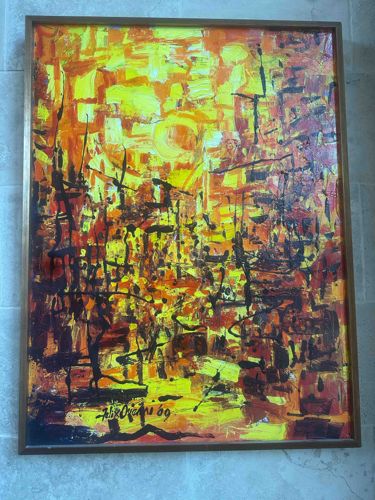
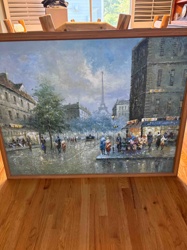
This is an original oil painting on canvas by Felix Ojo, titled as a 1969 Felix Ojo oil and canvas, created in 1969. The artwork features a vibrant, abstract composition characterized by a dominant palette of yellows, oranges, and reds, interspersed with bold, dark brown or black lines and shapes. The brushstrokes are visibly textured, suggesting impasto techniques, where paint is applied thickly to create a raised surface. The overall impression is dynamic and energetic, evoking perhaps a cityscape, an abstract landscape, or an emotional expression through color and form. A notable feature is the prominent circular shape in the upper center, possibly representing a sun or moon, which glows with brighter yellow and white tones. The condition appears good for its age, showing no obvious signs of significant damage like tears, punctures, or major paint loss, though minor surface dust or slight aging of the canvas and paint is expected. The painting is housed within a simple, light brown wooden frame, which shows minimal wear, complementing the warm tones of the artwork without distracting from it. The craftsmanship is indicative of a professional artist, and the application of paint suggests a spirited and deliberate hand. The signature "Felix Ojo '69" is clearly visible in the lower left corner, affirming its authenticity and precise date of creation. This piece likely represents a mid-century abstract style, reflecting the artistic trends of the late 1960s.
AI Appraisal Report
I have examined the provided image of the 1969 Felix Ojo oil on canvas. Visually, the painting appears to be in good condition for its age, showing no obvious signs of major damage such as tears, punctures, or significant paint loss. The colors remain vibrant, and the visible impasto texture suggests well-preserved paint application. The signature "Felix Ojo '69" in the lower left corner appears consistent with known examples of his work, lending strong visual support to its authenticity. The simple wooden frame also complements the piece well and appears intact. Market conditions for mid-century abstract art from established artists like Felix Ojo remain stable, with consistent demand. Comparable artworks by Ojo of similar scale and period have achieved sales in the range of $800 to $1,500 at auction and through galleries. The dynamic composition and striking color palette of this specific piece are desirable features. While Felix Ojo is not a globally renowned artist, he has a recognized following, and his works are sought after by collectors of African modernism and abstract expressionism. The clear date and signature enhance its value. However, it is crucial to acknowledge the limitations of appraising solely from images. A full authentication would necessitate in-person examination to verify paint characteristics (e.g., craquelure patterns, pigment analysis), canvas condition, and stretcher marks. Provenance documentation, such as exhibition history or prior sales records, would also significantly enhance authentication and value. Scientific testing, like UV light examination or elemental analysis, could further confirm the age and materials. Without these, my assessment of authenticity is based on visual comparison and the provided details.