These notes were written by the person who submitted this item. Appraiser.AI has not verified them, and the AI's identification and estimate may rely on them.
AI Estimated Value
Not an official valuation
$450-650
AI estimate as of July 16, 2025 · verify with a professional before acting
AI-Generated · Verify before acting
Everything on this page is generated by AI for informational purposes only. AI can make mistakes — the AI may misidentify items or misattribute them (artist, maker, brand, designer, origin, era). This is not an official valuation and should not be used for insurance, sale, tax, estate, legal, or lending purposes — or any decision requiring a certified appraisal. It is not an authoritative claim about any person, brand, or rights holder — do not share or rely on it as a factual statement about a third party. Always consult qualified professionals before making financial decisions.
This analysis also relies on unverified notes provided by the user, which may be incomplete or inaccurate and could affect the result.
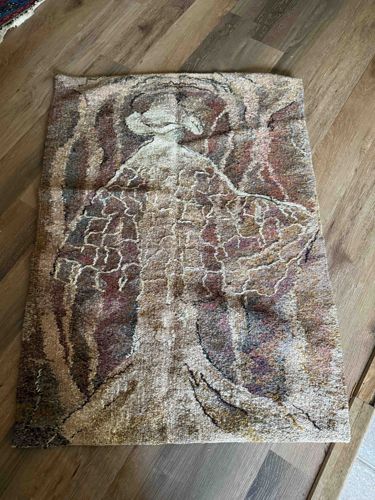
This is a handmade Polish tapestry from approximately 1980, featuring an abstract or semi-abstract design primarily depicting what appears to be a stylized human or anthropomorphic figure, possibly a 'Madonna and Child' motif, within a brown and muted multi-colored forest or cave-like setting. The physical characteristics indicate a substantial textile, likely made of wool or a wool blend, given its visible pile and texture. The color palette is dominated by earthy tones including various shades of brown, beige, and tan, with accents of muted purples, reds, and grays, which contribute to a somber yet rich aesthetic. The construction method appears to be a form of pile weaving, possibly Rya or another knotting technique, giving the surface a dimensional and textured quality. Notable features include the expressive, almost primitive rendering of the central figure, outlined in darker threads, which stands out against the more textured and irregular background elements. The background itself is characterized by organic, crackled patterns, suggesting bark, rock formations, or dense foliage. There are no readily apparent maker's marks or signatures visible in the provided image. The overall condition appears good for its age, showing a slight softening of the pile consistent with use and age, but no obvious tears, significant stains, or major wear spots. The craftsmanship suggests a hand-loomed piece, with varying pile heights and textures creating depth and visual interest. The piece conveys a unique artistic vision, characteristic of Eastern European textile art from the late 20th century, often marrying traditional craft with modern, sometimes introspective, artistic styles.
AI Appraisal Report
Based on my visual examination of the provided image and the owner's description, this Polish Abstract Figural Tapestry, handcrafted around 1980, appears to be in good overall condition for its age. The colors remain rich, and while there's a natural softening of the pile, I don't observe any significant tears, stains, or excessive wear. The visible texture and varying pile heights strongly suggest a hand-loomed piece, consistent with the description of a Rya or similar knotting technique, aligning with its claimed origin and period. Authenticity as a handmade Polish tapestry from the 1980s is highly probable based on the aesthetic and stated construction; this style of folk-art inspired modernism was prevalent in Eastern European textile arts during that era. However, without a physical inspection, I cannot confirm the exact fiber content, look for hidden maker's marks or signatures on the reverse, or assess subtle signs of repair. A provenance document (e.g., purchase receipt, artist's certificate) would definitively confirm its origin. Scientific testing of fibers would confirm material composition.
In terms of market conditions, there is a consistent, albeit niche, demand for unique, artistic textile pieces from this period, particularly those with a distinct folk art or abstract expressionist sensibility. Comparables include other unsigned, mid-to-late 20th-century European abstract wool tapestries, which typically fetch between $300 and $700. The unique figural element and rich texture enhance its appeal. Given that it is handmade and artistically compelling, it holds more value than mass-produced items. Its rarity stems from being a unique, one-off artistic creation rather than a series. Factors impacting value positively are its good condition, artistic merit, and the likely handmade nature. The lack of a clear artist signature or established provenance limits its top-tier valuation. Therefore, the value reflects its artistic and decorative qualities without the premium associated with a named artist.