AI estimate as of September 25, 2025 · verify with a professional before acting
AI-Generated · Verify before acting
Everything on this page is generated by AI for informational purposes only. AI can make mistakes — the AI may misidentify items or misattribute them (artist, maker, brand, designer, origin, era). This is not an official valuation and should not be used for insurance, sale, tax, estate, legal, or lending purposes — or any decision requiring a certified appraisal. It is not an authoritative claim about any person, brand, or rights holder — do not share or rely on it as a factual statement about a third party. Always consult qualified professionals before making financial decisions.
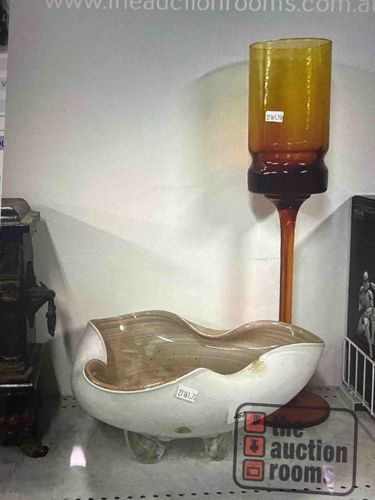
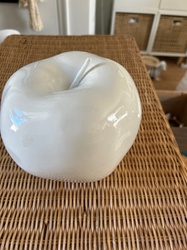
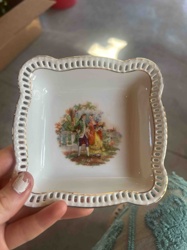
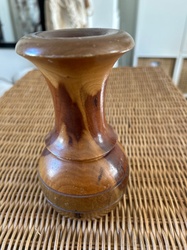
This lot appears to comprise several decorative art objects including a tall, amber and brown glass vase or candlestick holder, and a white and brown organic-shaped bowl with an accompanying stand. The glass component is cylindrical at the top portion, featuring a gradient color transition from a warm, translucent amber at the rim to a darker, opaque reddish-brown at its base. It then narrows dramatically into a slender, sculpted neck that culminates in a flat, circular brown base, suggesting it might be an integrated stand or a candle holder. The glass appears smooth and polished, exhibiting some reflections suggesting clarity, but also some internal texture or cloudiness near the amber section. A white paper sticker is attached to its amber section, likely an auction or inventory tag, with 'm12%' visible. The bowl, positioned in front of the glass object, has a distinctive organic and asymmetrical form. Its exterior is a matte or semi-gloss white, possibly ceramic, porcelain, or resin, with smooth, undulating curves. The interior of the bowl reveals a rich, wavy wood grain pattern in shades of light and medium brown, possibly a laminate, veneer, or a painted finish designed to mimic wood. The bowl itself rests on a series of small, indistinct feet, which appear to be part of its white base. A white sticker with illegible text and a price '2743.72' is affixed to the exterior side of the bowl. The overarching style suggests a Modern or Mid-Century Modern influence, possibly from the mid-20th century onwards, favoring clean lines and organic shapes. There are no obvious visible cracks, chips, or major damage, though the general condition appears to be 'as-is' as indicated by the auction setting. The craftsmanship appears to be commercial grade, designed for decorative rather than utilitarian purposes. The overall presentation indicates these are distinct art pieces, possibly sold together as a lot due to their complementary aesthetics and shared setting on a shelf.
AI Appraisal Report
Based on my visual examination of the provided image, this lot comprises a mixed-materials decorative art grouping, typical of mid to late 20th-century commercial production. The amber and brown glass object, likely a vase or a sophisticated candle holder, appears to be in good overall condition with no obvious chips or cracks. The white and wood-grain-interior bowl also appears intact, with its organic form suggesting a Modernist influence. The 'm12%' sticker on the glass and the '2743.72' sticker on the bowl indicate these are likely inventory or auction tags, giving context to their current presentation. Authenticity verification from images alone is limited; without hands-on inspection, I cannot confirm materials definitively (e.g., whether the bowl is ceramic, resin, or another composite, or if the wood grain is veneer or painted). Provenance documentation would be crucial to attribute these pieces to a specific designer or manufacturer. Market conditions for decorative objects of this type, without a known designer or significant history, tend to be modest. Comparables would include mass-produced decorative glassware and ceramic/resin bowls from the Mid-Century Modern or contemporary era available in secondary markets. Demand is moderate, primarily from individuals looking for accent pieces rather than collectible art. The absence of maker's marks or identifying signatures significantly impacts value, placing it in the decorative rather than fine art category. Full authentication and a more precise valuation would require physical inspection to assess material quality, craftsmanship, and the presence of any hidden marks or labels, as well as an assessment of the true condition beyond what is visible in the photograph.