AI estimate as of June 27, 2025 · verify with a professional before acting
AI-Generated · Verify before acting
Everything on this page is generated by AI for informational purposes only. AI can make mistakes — the AI may misidentify items or misattribute them (artist, maker, brand, designer, origin, era). This is not an official valuation and should not be used for insurance, sale, tax, estate, legal, or lending purposes — or any decision requiring a certified appraisal. It is not an authoritative claim about any person, brand, or rights holder — do not share or rely on it as a factual statement about a third party. Always consult qualified professionals before making financial decisions.
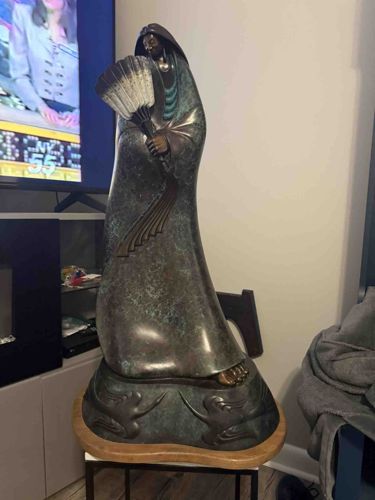
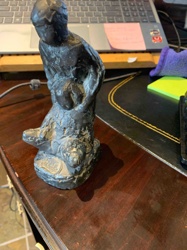
This is a large, imposing bronze sculpture depicting a standing woman, likely a Native American figure, holding a large fan. The sculpture exhibits a deep, variegated green and brown patina, suggesting an aged or antiqued finish, and some areas show a lighter, almost greenish-blue oxidation, adding to its character. The figure is draped in a flowing garment, possibly a blanket or robe, which conceals most of her body, leaving only her head, hands, and one foot visible at the base. The woman's face is rendered with notable features, including braided hair and what appears to be a beaded necklace in a vibrant turquoise color, contrasting with the bronze. Her expression seems contemplative or serene. She holds prominently a large, feathered fan, detailed with individual feathers, some of which appear lighter in tone, possibly depicting actual feathers or a contrasting material. The base of the sculpture is integrated, featuring stylized, wave-like or cloud-like motifs in relief. One bare foot of the figure is visible emerging from the drapery at the base, detailed with individual toes. The craftsmanship appears to be of high quality, indicative of a skilled sculptor. Visible condition issues include some minor surface abrasions or rub marks consistent with handling and display, but no significant damage or repairs are immediately evident. The overall impression is one of dignity and cultural significance, characteristic of Southwest or Native American inspired art. The size suggests it may be a floor-standing piece, making it a focal point in a space.
AI Appraisal Report
I've carefully examined the provided image of the bronze sculpture of a Native American woman. The condition appears to be good, with a desirable deep, variegated green and brown patina that suggests age and quality. The lighter greenish-blue oxidation adds to its character, indicating a natural aging process rather than significant damage. Minor surface abrasions are consistent with handling and display and do not detract significantly from its value. The craftsmanship, particularly in the detailed fan, braided hair, and the distinct toes on the visible foot, speaks to a skilled artisan.
From a market perspective, sculptures of Native American figures, especially those depicting dignity and cultural significance, maintain a steady demand within the art market, particularly in Southwest and Western art circles. Comparable bronze sculptures of this size and apparent quality, often by unlisted or lesser-known artists, typically range from $1,500 to $3,500. The "wave-like or cloud-like motifs" on the integrated base are a nice design element, suggesting a thoughtful composition.
Authenticity is difficult to definitively confirm from images alone. While the quality suggests it's not a mass-produced item, without a visible signature, foundry mark, or edition number, attributing it to a specific artist is impossible. In-person examination would allow for tactile assessment of the bronze's weight, temperature, and finer details not visible in photographs, as well as the presence of any hidden marks. Provenance documentation, such as purchase receipts or exhibition history, would significantly enhance its value by confirming origin and ownership. Scientific testing, like elemental analysis of the bronze, is typically reserved for high-value pieces where authenticity is strongly contested.