AI estimate as of August 2, 2025 · verify with a professional before acting
AI-Generated · Verify before acting
Everything on this page is generated by AI for informational purposes only. AI can make mistakes — the AI may misidentify items or misattribute them (artist, maker, brand, designer, origin, era). This is not an official valuation and should not be used for insurance, sale, tax, estate, legal, or lending purposes — or any decision requiring a certified appraisal. It is not an authoritative claim about any person, brand, or rights holder — do not share or rely on it as a factual statement about a third party. Always consult qualified professionals before making financial decisions.
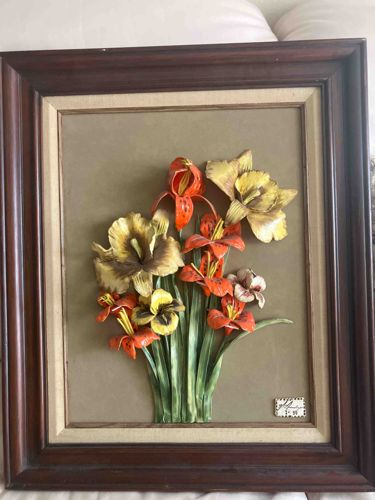
This is a framed three-dimensional floral arrangement, likely crafted from ceramic, porcelain, or a resin composite, giving it a relief sculpture appearance. The artwork depicts a bouquet of various flowers and foliage, presented in a naturalistic style. The dominant colors of the flowers are shades of yellow, orange, and reddish-brown, with some appearing to be irises or lilies due to their petal structure. The leaves and stems are rendered in shades of green. The individual floral elements are hand-painted, showing subtle variations in color and texture that suggest delicate craftsmanship. Each flower and leaf is individually formed and then arranged to create depth and dimension within the frame, rising several inches from the muted taupe or light brown fabric-covered matboard background. The matboard itself is set within a robust wooden picture frame with a dark reddish-brown finish, possibly mahogany or a stained hardwood, exhibiting a noticeable wood grain. The frame features a classic profile with a slightly stepped or molded edge, suggesting a traditional or classic aesthetic. There is a smaller, lighter-colored inner mat or liner between the main matboard and the frame, which provides a visual separation and enhances the framed artwork. Visible condition issues include some minor dust accumulation on the surface of the floral elements, particularly in crevices, and a very small blemish or light scratch on the top edge of the wooden frame. At the bottom right corner of the floral arrangement, there is a small rectangular white tag or plaque, possibly indicating a manufacturer's mark, artist's signature, or series number, though the text is illegible from the image provided. The overall style suggests a mid-20th century to late 20th century decorative art piece, designed for interior wall display. The quality of the molding and painting indicates a skilled artisan or manufacturer, with attention to detail in replicating natural forms.
AI Appraisal Report
I have carefully examined the provided image of this Three-Dimensional Framed Floral Wall Art. This piece, likely crafted from ceramic, porcelain, or resin, displays a sophisticated rendering of a floral bouquet with notable depth and dimension, standing several inches proud of its fabric-covered matboard background. The flowers, primarily in shades of yellow, orange, and reddish-brown, are hand-painted with fine detail, suggesting skilled craftsmanship. The robust dark reddish-brown wooden frame, with its classic profile and inner liner, complements the artwork's traditional aesthetic.
My assessment of its condition, based solely on the image, notes minor dust accumulation within the floral elements and a small blemish on the top edge of the frame. These are typical for decorative items of this nature and age and are easily rectifiable or minor, not significantly impacting value. The small, illegible tag at the bottom right is of interest; a physical inspection would be crucial to determine if it’s a manufacturer's mark, artist's signature, or series number, which could significantly impact authenticity and value.
In terms of market conditions, similar three-dimensional floral art pieces from the mid to late 20th century typically fall into the decorative art category. While there is a consistent demand for well-executed decorative items suitable for traditional interiors, this specific style is not in high demand as a collectible art form, unless attributed to a highly recognized studio or artist. Its rarity is moderate; while not mass-produced, many such pieces were created.
The primary factors impacting value include the material quality, the level of artistic detail, and potential attribution. Without physical inspection, I cannot definitively confirm the material (ceramic vs. resin) or the legibility of the tag. For full authentication and to ascertain the highest possible value, I would require in-person examination to assess material, feel brushstrokes, verify artist's marks, and investigate provenance documentation. Scientific testing for material composition is also beyond the scope of image-based appraisal.
Given the visible quality and condition, and in absence of a prominent artist attribution, this piece is appraised as a high-quality decorative item.