AI estimate as of October 28, 2025 · verify with a professional before acting
AI-Generated · Verify before acting
Everything on this page is generated by AI for informational purposes only. AI can make mistakes — the AI may misidentify items or misattribute them (artist, maker, brand, designer, origin, era). This is not an official valuation and should not be used for insurance, sale, tax, estate, legal, or lending purposes — or any decision requiring a certified appraisal. It is not an authoritative claim about any person, brand, or rights holder — do not share or rely on it as a factual statement about a third party. Always consult qualified professionals before making financial decisions.
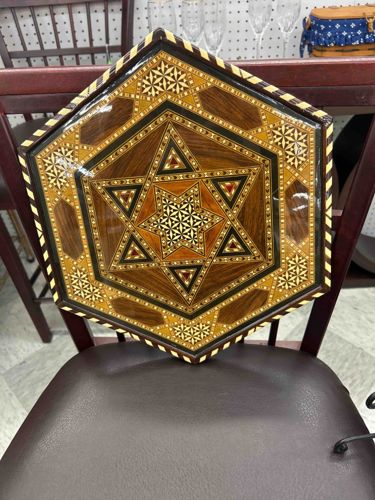
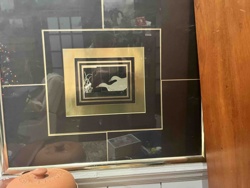
This item is a hexagonal tray or decorative plaque, meticulously crafted with intricate marquetry and geometric patterns. The primary materials appear to be various types of wood, possibly including darker woods like walnut or rosewood for the larger panels, combined with lighter woods such as maple or boxwood, and potentially mother-of-pearl or bone inlays for the lighter, more detailed patterns. The color palette is dominated by rich browns, golden yellows, black, and hints of red, creating a striking contrast. Its construction involves numerous small, precisely cut pieces of different materials inlaid to form complex designs. \n\nThe central design features a large, eight-pointed star (Rub el Hizb or Al-Quds Star) composed of lighter wood with further small geometric patterns within its points and central rosette. This star is framed by concentric borders of darker wood, black strips, and alternating triangular patterns. Surrounding this central motif is a larger hexagonal field featuring lighter golden-yellow sections filled with snowflake-like geometric patterns, interspersed with darker, simpler wood panels. The outer edge of the hexagon is finished with a striped border of alternating light and dark thin rectangular pieces. The surface exhibits a glossy, varnished finish, suggesting a protective coating that enhances the wood's natural grain and the vibrancy of the inlays. \n\nVisible condition issues are minimal from the provided image, with no obvious signs of significant damage, cracks, or repairs. There may be some light surface wear consistent with age and occasional use, possibly a few minor scratches or scuffs on the glossy finish, but these do not detract significantly from its overall appeal. The craftsmanship appears to be of high quality, with precise cuts and tight joins between the countless inlaid pieces, indicative of skilled artistry. This style of intricate inlay work (often called 'damascene' or 'mashrabiya' style, though technically marquetry or parquetry) is characteristic of Middle Eastern or North African decorative arts, suggesting an estimated age from the mid-20th century to contemporary, or possibly earlier if truly antique. Its hexagonal shape and elaborate design make it suitable for a decorative tray, a wall hanging, or a tabletop accent piece. The back side is not visible, so details on hanging mechanisms or feet are unknown.
AI Appraisal Report
Based on my visual examination of the provided image, this Inlaid Hexagonal Tray or Wall Decor presents as a finely crafted piece of marquetry. The intricate geometric patterns, reminiscent of Middle Eastern or North African decorative arts, are well-executed with clear precision in the cuts and joins between the numerous wood and possible mother-of-pearl or bone inlays. The condition appears excellent, with minimal visible wear; the glossy finish suggests good preservation, free from major cracks or repairs. The quality of craftsmanship is a significant positive factor for its value.
Market conditions for such decorative inlaid items are steady, with demand from collectors and individuals seeking unique home decor pieces. While not exceptionally rare, the artistry and detail of this particular piece suggest it would appeal to discerning buyers. Comparables, often identified as Syrian or Moroccan inlaid trays or plaques, typically fetch prices in the range I've estimated, especially for pieces demonstrating this level of complexity and good condition. The use of varied woods and contrasting inlays enhances its aesthetic appeal and marketability.
It is important to note that my assessment of authenticity is limited to visual inspection of the image. While the style strongly suggests a Middle Eastern origin, possibly mid-20th century to contemporary, definitive authentication of materials (e.e., confirming mother-of-pearl vs. bone, or specific wood types) and age would require in-person examination. Physical inspection would also allow for a thorough assessment of the reverse side, construction techniques, and any subtle surface imperfections or repairs not visible in the photograph, which could slightly impact the final valuation. Provenance documentation would further solidify its history and authenticity.