These notes were written by the person who submitted this item. Appraiser.AI has not verified them, and the AI's identification and estimate may rely on them.
AI Estimated Value
Not an official valuation
$25 - $40
AI estimate as of November 9, 2025 · verify with a professional before acting
AI-Generated · Verify before acting
Everything on this page is generated by AI for informational purposes only. AI can make mistakes — the AI may misidentify items or misattribute them (artist, maker, brand, designer, origin, era). This is not an official valuation and should not be used for insurance, sale, tax, estate, legal, or lending purposes — or any decision requiring a certified appraisal. It is not an authoritative claim about any person, brand, or rights holder — do not share or rely on it as a factual statement about a third party. Always consult qualified professionals before making financial decisions.
This analysis also relies on unverified notes provided by the user, which may be incomplete or inaccurate and could affect the result.
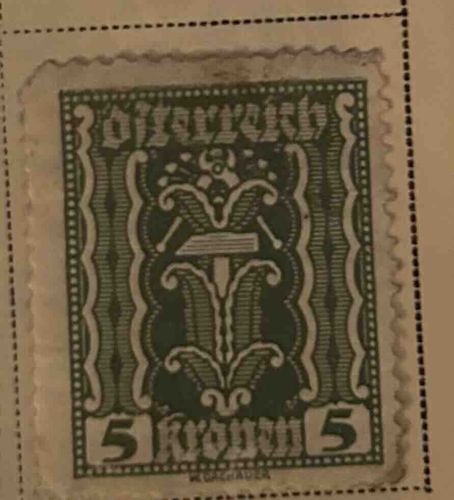
This item is a postage stamp, likely from Austria, given the prominent 'Osterreich' (German for Austria) at the top. The stamp is rectangular with perforated edges, indicating it was designed to be separated from a sheet. The color appears to be a dark green or teal, printed on what seems to be off-white or cream-colored paper. The design is intricate and ornate, featuring a central stylized motif that includes what resembles a hammer and an architectural element or a symbolic device, perhaps related to industry or heraldry. The numerical value '5' is found in two corners at the bottom, flanking the word 'Kronen', suggesting a denomination of 5 Kronen. Below 'Kronen', there is very small text that appears to read 'W. DACHAUER', likely indicating the designer or engraver of the stamp. The stamp exhibits signs of age and wear, including some discoloration and minor creasing or softening around the edges and corners. There are slight visible surface scuffs or specks on the design, and the perforation integrity is somewhat compromised in areas. The overall condition suggests it has been handled or stored, possibly as part of a collection, but is not in pristine, uncirculated condition. The style of typography and the currency 'Kronen' suggest a historical period, likely late 19th or early 20th century, a time when the Austro-Hungarian Empire would have used such currency. The detailed engraving points to quality craftsmanship typical of national postal services for currency and stamps of that era.
AI Appraisal Report
I have carefully examined the provided image of the Austria 5 Kronen stamp. Visually, the stamp appears authentic given the design elements, typography, and 'Osterreich' inscription consistent with Austrian issues of the late 19th or early 20th century. The 'W. DACHAUER' inscription also points to a known engraver for this period.
From the image, the stamp's condition is fair to good, but not pristine. I observe some discoloration, minor creasing, and softening around the perforated edges. Some perforations appear compromised, and surface scuffs are visible. This indicates it has been handled and likely removed from its original context, which slightly diminishes its value compared to a never-hinged or superb-condition example.
In terms of market conditions, this particular 5 Kronen denomination from Austria is generally not considered exceptionally rare, especially if it's a common perf and paper variety. Demand is steady among collectors of Austrian philately but typically not high-speculative. Comparables for used, sound-to-good condition examples of this stamp usually fall within a modest range. Factors significantly impacting value include the stamp's exact issue (numerous variations exist for Austrian stamps), precise perforation type, watermarks (not discernible from the image), and ultimately, its physical state.
It is crucial to note that authenticity verification from images alone has limitations. I cannot definitively confirm paper type, watermarks, gum condition (if applicable to an unused example, though this appears used), or the exact perforation gauge. These details, along with a physical examination for any repairs, hidden faults, or expert marks, would be needed for a full and conclusive authentication and a more precise valuation. My assessment is based purely on the visual information available.