AI Appraisal Estimate

AI-generated estimates · not official valuations

From the user

What was submitted

Photo and notes provided by the user — not generated by AI

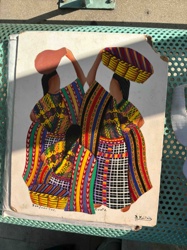
Submitted item photo
Submitted photo · June 13, 2026

User's notes

No additional notes provided.

AI analysis below

AI appraisal

AI analysis & estimate

AI-Generated · Verify before acting

Everything below is generated by AI for informational purposes only. AI can make mistakes — the AI may misidentify items or misattribute them (artist, maker, brand, designer, origin, era). This is not an official valuation and should not be used for insurance, sale, tax, estate, legal, or lending purposes — or any decision requiring a certified appraisal. It is not an authoritative claim about any person, brand, or rights holder — do not share or rely on it as a factual statement about a third party. Always consult qualified professionals before making financial decisions.

Read the full disclaimer

AI Identification

·Not independently authenticated·Verify before acting

Cusco School Style Painting of the Archangel Michael

Religious Fine Art / Latin American Colonial Style Painting

AI Estimated Value

·Not an official valuation·Verify before acting

$450 - $700

As of June 13, 2026

AI Item Analysis

·AI can make mistakes·Verify before acting
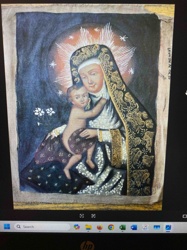
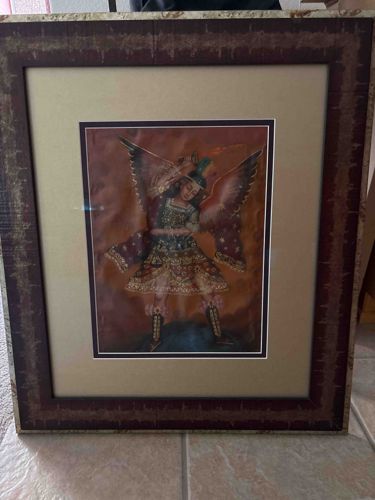
This is a framed painting executed in the tradition of the Cusco School (Escuela Cuzqueña), a colonial artistic movement from Peru. The central figure depicts the Archangel Michael, portrayed as an 'Ángel Arcabucero' or celestial warrior. He is characterized by elaborate, heavy wings and a richly ornamented garment consisting of a brocaded tunic and skirt, accented with intricate gold-leaf detailing (estofado). The figure wears decorative buskin boots and a feathered hat, standing atop a dark celestial orb or landscape. The color palette is dominated by deep reds, earthy browns, and shimmering gold tones against a warm, atmospheric background. The painting appears to be on canvas or a textured panel with visible undulations, suggesting a traditional hand-painted surface. It is mounted within a wide, double-matted frame; the outer mat is a neutral taupe, while the inner mat is a dark chocolate with a white core. The frame is a contemporary wooden mould with a dark mahogany finish and a distinctive gold metallic distressed pattern along the edges. The condition appears fair to good with some surface ripple in the support, but no significant flaking or loss is immediately visible. This piece likely dates to the late 20th century as a high-quality reproduction of the 17th-18th century colonial style.
AI Appraisal Report

·AI can make mistakes·Verify before acting
I have carefully examined the visual representation of this 'Ángel Arcabucero' painting in the Cusco School style. The work displays the hallmarks of late 20th-century artisanal production: while it successfully captures the iconographic spirit of 17th-century Peruvian masters—notably the 'brocateado' (gold-leaf overlay) and the characteristic arquebusier attire—the surface undulations and the specific texture of the crackle-pattern suggest a modern canvas treated to simulate age. The framing is contemporary, utilizing machine-milled molding with a faux-distressed finish, further supporting a 20th-century origin. The market for high-quality Cusco School reproductions is stable, supported by interior designers and collectors of religious iconography. Authentic colonial-era pieces from the 17th or 18th century would command values exceeding $5,000–$15,000; however, as a modern devotional or decorative work, value is driven by size, frame quality, and the level of detail in the gold leafing. The condition is good, though the visible ripples in the canvas suggest it may require professional re-tensioning. Critically, this appraisal is based on photographic evidence alone. To definitively rule out an earlier origin, a physical inspection is required to analyze the weave of the canvas, the composition of the pigments (checking for modern synthetics versus mineral-based paints), and the presence of any hand-forged nails or historic joinery on the stretcher bars. A full authentication would necessitate provenance documentation and possibly spectroscopic analysis to verify the age of the binding agents. Given the current visual data, the item is valued as a high-end decorative reproduction.

Get your items appraised

Instant estimates of your treasures with AI-powered appraisals

Browse More Appraisals