These notes were written by the person who submitted this item. Appraiser.AI has not verified them, and the AI's identification and estimate may rely on them.
AI Estimated Value
Not an official valuation
$800 - $1,500
AI estimate as of July 18, 2025 · verify with a professional before acting
AI-Generated · Verify before acting
Everything on this page is generated by AI for informational purposes only. AI can make mistakes — the AI may misidentify items or misattribute them (artist, maker, brand, designer, origin, era). This is not an official valuation and should not be used for insurance, sale, tax, estate, legal, or lending purposes — or any decision requiring a certified appraisal. It is not an authoritative claim about any person, brand, or rights holder — do not share or rely on it as a factual statement about a third party. Always consult qualified professionals before making financial decisions.
This analysis also relies on unverified notes provided by the user, which may be incomplete or inaccurate and could affect the result.
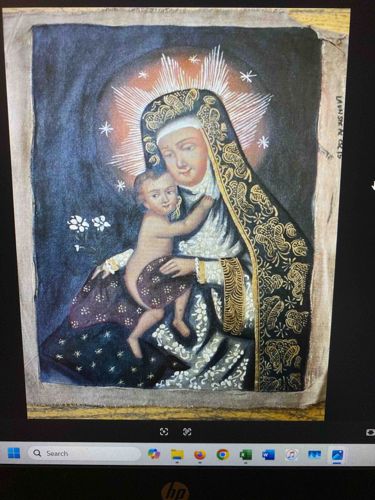
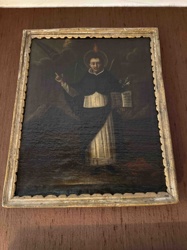
This is a two-dimensional artwork depicting the Madonna and Child, consistent with the style of Peruvian Cusco School art. The painting features the Virgin Mary, shown in a frontal or slightly three-quarter pose, cradling the infant Jesus. Mary is adorned in elaborate robes and a veil, predominantly dark tones, likely black or deep blue, enriched with intricate gold and silver-toned patterns that suggest embroidery or brocade. The patterns are highly stylized, featuring floral or curvilinear motifs, indicative of Colonial Baroque influence often seen in Cusco art. Jesus, depicted as an infant, is partially draped in a patterned cloth, possibly reddish-brown or dark maroon with white polka dots, and has fair skin. Both figures have halos, with Mary's halo radiating light outwards in a sunburst pattern with white rays, and stars are interspersed in the dark background around her head. The background is a dark, indeterminate space, possibly suggesting night or a void, with white floral elements visible to the left of the Virgin. The painting appears to be executed on a rigid support, possibly stretched canvas or panel, and is framed by a border of what appears to be a light brown or gold color, giving it a somewhat rustic or aged appearance. The visible texture suggests impasto or layers of paint, particularly in the decorative elements. The overall condition shows some visible wear, including what might be small cracks or losses in the paint layer, particularly along the edges and within the background, consistent with its age. There is a faint inscription or signature in the upper right corner, partially visible, which reads 'LAVRA (?)N. C. CRIS'. The craftsmanship is notable for its detailed ornamentation and the expressive faces of the figures, common characteristics of Cusco School paintings which blend European religious iconography with native Andean artistic traditions. The coloring is rich and vibrant despite potential age-related patina.
AI Appraisal Report
I have examined the provided image of this Peruvian Cusco School painting depicting the Madonna and Child. Based solely on this visual assessment, the artwork exhibits stylistic characteristics consistent with Colonial Baroque influence and the distinctive features of Cusco School art, such as the elaborate vestments, detailed patterns, and the blend of European iconography with what appears to be indigenous artistic conventions.
The condition, as observed from the image, shows visible signs of age including what seem to be minor paint losses, cracking, and surface wear, particularly along the edges and in the background. This is expected for an artwork of this suspected vintage. The colors remain rich, suggesting pigments of good quality. The visible impasto and detailed ornamentation are hallmarks of this school.
Regarding authenticity, while the visual cues are compelling, I must stress that a definitive authentication is impossible from images alone. The faint inscription 'LAVRA (?)N. C. CRIS' in the upper right corner is intriguing but would require in-person examination to decipher fully and investigate its meaning or connection to known artists. For full authentication, I would need to physically examine the painting to assess brushwork, pigments, and support materials more closely. Additionally, provenance documentation (history of ownership) is crucial, as is potential scientific testing (such as pigment analysis or dendrochronology for panel supports) to confirm age and materials. Without these, the 'Peruvian Cusco Art of Mary and Child' description remains an assumption based on visual style.
In terms of market conditions, Cusco School paintings, particularly religious subjects, generally command a steady but modest demand. Their rarity is moderate; while many were produced, truly high-quality or well-documented examples are less common. Factors significantly impacting value include verifiable authenticity, a strong provenance, the condition, the artistic merit (which appears good here), and the presence of artist signatures or workshop attributions. The inscription, if decipherable and attributable, would be a strong value driver. Without physical inspection and provenance, this piece would likely be placed in the broader category of 'attributed to' or 'in the style of' rather than definitively by a known artist, which affects its top-end value. Given these factors, particularly the lack of definitive authentication and provenance from an image, I would conservatively appraise this piece.