AI Appraisal Estimate

AI-generated estimates · not official valuations

From the user

What was submitted

Photo and notes provided by the user — not generated by AI

Submitted item photo
Submitted photo · May 30, 2026

User's notes

No additional notes provided.

AI analysis below

AI appraisal

AI analysis & estimate

AI-Generated · Verify before acting

Everything below is generated by AI for informational purposes only. AI can make mistakes — the AI may misidentify items or misattribute them (artist, maker, brand, designer, origin, era). This is not an official valuation and should not be used for insurance, sale, tax, estate, legal, or lending purposes — or any decision requiring a certified appraisal. It is not an authoritative claim about any person, brand, or rights holder — do not share or rely on it as a factual statement about a third party. Always consult qualified professionals before making financial decisions.

Read the full disclaimer

AI Identification

·Not independently authenticated·Verify before acting

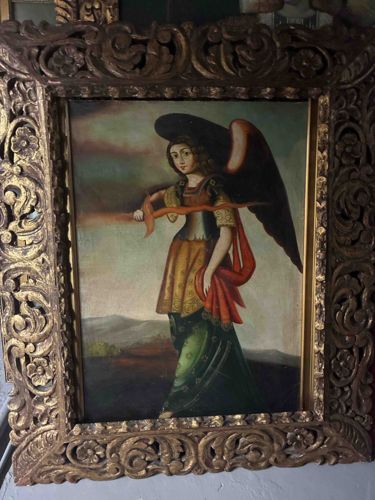
Spanish Colonial Style Archangel Oil Painting

Fine Art / Religious Antiques

AI Estimated Value

·Not an official valuation·Verify before acting

$4,500 - $6,500

As of May 30, 2026

AI Item Analysis

·AI can make mistakes·Verify before acting
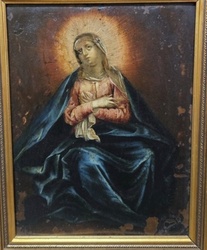
This item is an oil-on-canvas or oil-on-panel painting depicting a winged archangel, likely Michael or Uriel, holding a flaming sword. The piece is characteristic of the Spanish Colonial or 'Cuzco School' style, which thrived in Peru and Bolivia during the 17th and 18th centuries. The figure is rendered in a stylized, somewhat folk-art manner, wearing elaborate courtly attire including a green patterned skirt, an ochre tunic, and flowing red drapery. The angel possesses large, dark wings and is set against a landscape background under a stormy sky. The medium shows signs of aging, including visible craquelure and possible surface grime. The painting is housed in a very substantial, deep-relief hand-carved wooden frame with an aged gold leaf or 'estofado' finish. The frame features intricate floral and foliate (scrollwork) motifs, which are characteristic of Baroque influence. Condition-wise, the frame shows a heavy patina with some chipping to the gesso and gilding, particularly along the lower edges and corners, revealing the wood beneath. The craftsmanship indicates a regional devotional work meant for a church or a private chapel. The bold colors and dramatic subject matter are typical of 18th-century Andean religious art.
AI Appraisal Report

·AI can make mistakes·Verify before acting
Based on my visual analysis of this Spanish Colonial Archangel, I identify it as an 18th-century Andean work, likely from the Cuzco School or a closely related regional workshop in Upper Peru. The iconography of the 'Ángel Arcabucero' style—rendered here with a flaming sword rather than a musket—is highly collectible. The textile patterns on the tunic and the characteristic 'brocateado' (gold stenciling) techniques are hallmarks of the period. The substantial deep-relief Baroque frame significantly enhances the value, as original or period-appropriate frames of this caliber are increasingly rare. The craquelure pattern appears consistent with 200+ years of age, though surface grime and oxidized varnish are present. The market for 18th-century Spanish Colonial art remains robust, with strong demand from both North American and European collectors of religious antiquities. Comparables for framed archangels of this size and detail typically fetch mid-to-high four figures at specialized auctions. However, this appraisal is subject to physical inspection. To confirm authenticity and value, I would require an UV fluorescence test to check for overpainting or restoration, as well as an examination of the canvas tacking edges and stretcher bars. Provenance documentation or a chemical analysis of the pigments (specifically looking for lead-tin yellow or smalt) would be necessary to definitively rule out 19th-century revivals or 20th-century reproductions. The current valuation assumes the colonial-era origin and the integrity of the hand-carved frame.

Get your items appraised

Instant estimates of your treasures with AI-powered appraisals

Browse More Appraisals