AI identification & appraisal estimate

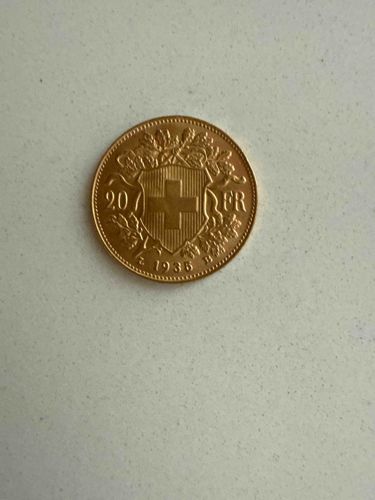
1935 Swiss 20 Francs Vreneli Gold Coin (Reverse)

Submitted photo of 1935 Swiss 20 Francs Vreneli Gold Coin (Reverse)
Photo submitted by the user — not generated by AI

AI Estimated Value

Not an official valuation

$420-500

AI estimate as of November 4, 2025 · verify with a professional before acting

AI-Generated · Verify before acting

Everything on this page is generated by AI for informational purposes only. AI can make mistakes — the AI may misidentify items or misattribute them (artist, maker, brand, designer, origin, era). This is not an official valuation and should not be used for insurance, sale, tax, estate, legal, or lending purposes — or any decision requiring a certified appraisal. It is not an authoritative claim about any person, brand, or rights holder — do not share or rely on it as a factual statement about a third party. Always consult qualified professionals before making financial decisions.

Read the full disclaimer

AI Item Analysis

This is a gold coin, specifically the reverse side of a Swiss 20 Francs 'Vreneli' coin, dated 1935. The coin is circular and displays a warm, rich gold color typical of high-purity gold. Its surface appears to have a slightly matte or brushed finish, with raised design elements featuring a subtle sheen. The central design prominently features the Swiss coat of arms, a shield displaying an upright, equal-armed cross, enclosed by a wreath of oak leaves on the left and perhaps laurel or another leafy branch on the right. Below the shield, the minting year '1935' is clearly visible. To the left and right of the shield, the denomination '20 FR' is inscribed, with '20' on the left and 'FR' on the right. The rim of the coin has a finely milled edge, indicative of secure manufacture and to deter clipping. There are no obvious signs of significant wear such as heavy scratching, denting, or edge damage. The details of the foliage and the cross are sharp and well-defined, suggesting a well-preserved condition, possibly uncirculated or lightly circulated. The overall craftsmanship appears to be of high quality, consistent with national coinage. The particular year '1935' for Swiss Vreneli coins often falls into a category of restrikes, though without seeing the obverse or knowing mint details, it's difficult to confirm definitively from this image alone. The coin represents a classic European gold bullion coin of the early 20th century.

AI Appraisal Report

Based on my visual examination of the provided image, this 1935 Swiss 20 Francs Vreneli gold coin (reverse) appears to be in excellent condition, likely uncirculated or near uncirculated. The details on the Swiss coat of arms, the oak and laurel wreath, and the '20 FR' denomination along with the '1935' date are sharp and well-defined. The surface exhibits a pleasing gold luster, and there are no apparent significant scratches, dents, or rim damage. The finely milled edge is also consistent with high-quality coinage. The 1935 Vreneli coin is a widely recognized gold bullion piece. While the year 1935 coins are technically restrikes (typically from 1945), they are genuine Swiss government issues and are highly liquid in the market. The value of this coin is primarily tied to its gold content, which is 0.1867 troy ounces (5.9 grams) of 90% pure gold. Current market conditions for gold are strong, supporting a solid base value for this coin. Demand for these classic European gold coins remains consistently high among both collectors and investors seeking fractional gold exposure. Due to the high mintage of restrikes, these coins are not inherently rare, but their historical appeal and gold content ensure steady demand. Coins in this seemingly high-grade condition often command a modest premium over their melt value, typically 10-25% depending on the exact grade and dealer. My valuation of $420-500 reflects the current spot price of gold plus a typical premium for a well-preserved example. However, it is crucial to note the limitations of determining authenticity and exact grade from an image alone. A physical in-person examination is essential to verify authenticity, weigh the coin, and accurately assess its precise condition (e.g., surface hairlines, contact marks not visible in the image) and determine if it has been cleaned. I would also look for specific mint marks (e.g., 'L' for Langenargen) that distinguish the 1935 restrikes, though this is primarily an obverse detail. Full authentication would ideally involve verifying its weight, dimensions, and possibly specific gravity testing.

Keep exploring

More coin appraisals

Get your items appraised

Instant AI-powered appraisal estimates from a photo

Browse More Appraisals