AI estimate as of July 17, 2025 · verify with a professional before acting
AI-Generated · Verify before acting
Everything on this page is generated by AI for informational purposes only. AI can make mistakes — the AI may misidentify items or misattribute them (artist, maker, brand, designer, origin, era). This is not an official valuation and should not be used for insurance, sale, tax, estate, legal, or lending purposes — or any decision requiring a certified appraisal. It is not an authoritative claim about any person, brand, or rights holder — do not share or rely on it as a factual statement about a third party. Always consult qualified professionals before making financial decisions.
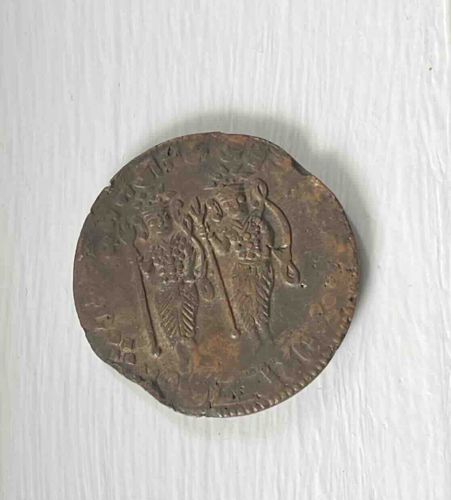
This item is an ancient coin, likely made of bronze or copper due to its reddish-brown color and visible patination. The coin is circular, though its edges are irregular and show signs of degradation, suggesting significant time in circulation or burial. There are no discernible markings on the reverse or any indications of its original metallic composition. The obverse prominently features two figures in what appears to be traditional or ceremonial attire, possibly deities or rulers, standing upright and facing forward. Each figure holds a staff or scepter. The details of their faces and clothing are somewhat worn but still distinguishable, showcasing what seems to be intricate headwear and patterned garments. Around the periphery of the coin, there are visible remnants of a circular inscription, though most of the characters are illegible due to wear and corrosion. The overall condition of the coin indicates significant age and environmental exposure, contributing to a rich, dark brown patina that has oxidized much of the surface. There are visible nicks and areas where the metal has chipped away, particularly along the rim. The craftsmanship, despite the wear, suggests a hand-struck process typical of ancient coinage, indicating an estimated age ranging from ancient to medieval periods. The depth of the relief for the figures is modest, suggesting a common minting technique.
AI Appraisal Report
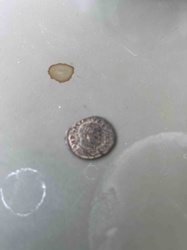
I have carefully examined the provided image of this ancient bi-figural coin. Based on its reddish-brown color, visible patination, and irregular edges, it appears to be a bronze or copper alloy, consistent with ancient coinage. The wear and degradation suggest significant age and environmental exposure. The obverse displays two figures, likely deities or rulers, holding staffs, with apparent intricate headwear and patterned garments. Remnants of a circular inscription are visible but illegible, significantly limiting identification. The reverse is completely unidentifiable from the image.
Assessing authenticity solely from an image is challenging; however, the typical hand-struck process and general appearance are consistent with ancient to medieval coinage. Without physical inspection, I cannot confirm the metal composition, specific mint, or exact period. In-person examination would allow for precise measurements, weight analysis, and tactile assessment of the relief and surface anomalies. Scientific testing, such as XRF analysis for metal composition and patina analysis, would be crucial for definitive authentication and dating.
Due to the illegibility of inscriptions and the lack of a clear reverse, identifying specific comparable coins is impossible. This significantly impacts market value. Unidentified ancient coins, even with interesting iconography, typically fetch lower prices compared to clearly attributed pieces. While there is a general demand for ancient artifacts, the vagueness of this item limits its rarity appeal to specialized collectors. The heavily worn condition, illegible inscriptions, and lack of a reverse design are major negative factors.
Given these limitations, this coin would appeal more to a general interest collector rather than a specialist seeking historically significant examples. For a full authentication and more precise valuation, I would require a direct physical examination, potentially coupled with provenance documentation if available, and certainly scientific analysis.