AI Appraisal Estimate

AI-generated estimates · not official valuations

From the user

What was submitted

Photo and notes provided by the user — not generated by AI

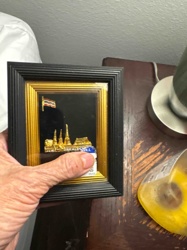
Submitted item photo
Submitted photo · June 25, 2026

User's notes

No additional notes provided.

AI analysis below

AI appraisal

AI analysis & estimate

AI-Generated · Verify before acting

Everything below is generated by AI for informational purposes only. AI can make mistakes — the AI may misidentify items or misattribute them (artist, maker, brand, designer, origin, era). This is not an official valuation and should not be used for insurance, sale, tax, estate, legal, or lending purposes — or any decision requiring a certified appraisal. It is not an authoritative claim about any person, brand, or rights holder — do not share or rely on it as a factual statement about a third party. Always consult qualified professionals before making financial decisions.

Read the full disclaimer

AI Identification

·Not independently authenticated·Verify before acting

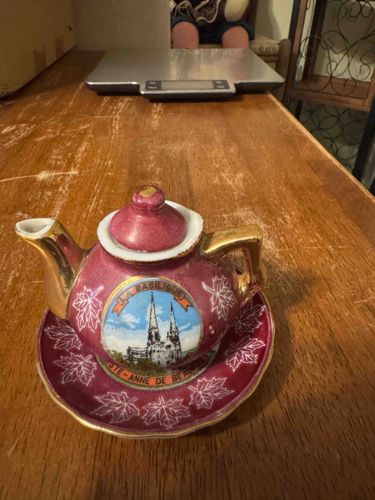
Souvenir Miniature Teapot and Saucer (Basilica Sainte-Anne-de-Beaupré)

Decorative Souvenir

AI Estimated Value

·Not an official valuation·Verify before acting

$15-25

As of June 25, 2026

AI Item Analysis

·AI can make mistakes·Verify before acting
This is a miniature decorative teapot with a matching saucer, likely made of ceramic or porcelain. The primary color of both pieces is a rich, deep maroon or burgundy, accented with gold trim. The teapot features a small handle and spout, both finished in gold, with a golden band around the rim and the edge of the lid. The lid itself is also maroon with a gold knob. A prominent circular medallion with a light blue border is centrally located on the side of the teapot. This medallion depicts a detailed illustration of a large, neo-Gothic cathedral with two prominent spires, identified by text above as "LA BASILIQUE" and below as "STE-ANNE DE BEAUPRÉ," indicating the Basilica of Sainte Anne de Beaupré in Quebec, Canada. White or light-colored maple leaf motifs are scattered across the maroon surface of both the teapot and the saucer, suggesting a Canadian origin. The white interior of the teapot's mouth is visible. The saucer follows the same color scheme and maple leaf pattern, with a gold rim. The item appears to be in good condition with no visible cracks, chips, or significant wear to the paint or gold accents. Its small size suggests it is a decorative souvenir item rather than a functional tea-serving piece. The craftsmanship appears to be commercial grade, typical of souvenir items, with clear printing on the medallion and consistent application of color and gold trim. The style is commemorative, indicating it was produced to be a memento of a visit to the basilica. Given its souvenir nature, it likely dates from the mid-to-late 20th century or more recently.
AI Appraisal Report

·AI can make mistakes·Verify before acting
I have carefully examined the provided image of the Souvenir Miniature Teapot and Saucer (Basilica Sainte-Anne-de-Beaupré). Based on this visual inspection, the item appears to be in good condition, showing no obvious signs of chips, cracks, or significant paint loss. The gold trim also looks intact and well-preserved. There are no immediate red flags regarding authenticity from the image alone, and the design elements (Basinlica depiction, maple leaves) are consistent with souvenir items from Quebec. This piece is a decorative souvenir, likely made of ceramic or porcelain, commemorating the Basilica of Sainte Anne de Beaupré. Its small size confirms its intended use as a memento rather than a functional tea set. Dating is difficult from imagery, but the style suggests mid-to-late 20th century production. Market-wise, miniature souvenir teapots and saucers generally fall into a niche collectibles market. Demand is typically moderate, driven by collectors of souvenir ware, Canadian memorabilia, or specific religious sites. Rarity is low; these items were mass-produced. Comparable sales of similar souvenir teacup/saucer sets reflecting tourist attractions generally range from $10 to $30. The primary factor influencing its value is its condition, which appears excellent. However, its mass-produced nature and lack of provenance limit higher valuations. To fully verify authenticity and confirm the material composition, a physical inspection would be necessary. This would allow for a tactile examination for crazing, precise material identification, and a closer look at manufacturing marks, which are not visible in the image. Without physical examination or documentation of its origin/history, my assessment is based solely on visual characteristics.

Get your items appraised

Instant estimates of your treasures with AI-powered appraisals

Browse More Appraisals