These notes were written by the person who submitted this item. Appraiser.AI has not verified them, and the AI's identification and estimate may rely on them.
AI Estimated Value
Not an official valuation
$15-35
AI estimate as of November 4, 2025 · verify with a professional before acting
AI-Generated · Verify before acting
Everything on this page is generated by AI for informational purposes only. AI can make mistakes — the AI may misidentify items or misattribute them (artist, maker, brand, designer, origin, era). This is not an official valuation and should not be used for insurance, sale, tax, estate, legal, or lending purposes — or any decision requiring a certified appraisal. It is not an authoritative claim about any person, brand, or rights holder — do not share or rely on it as a factual statement about a third party. Always consult qualified professionals before making financial decisions.
This analysis also relies on unverified notes provided by the user, which may be incomplete or inaccurate and could affect the result.
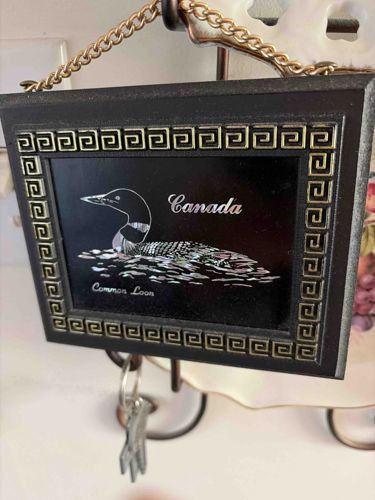
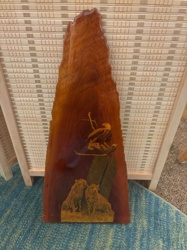
This item is a small, rectangular framed plaque, likely intended as a souvenir. The frame is dark, possibly black or very dark brown, with a matte or slightly textured finish. It features a continuous border of gold-colored Greek key (meander) ornamentation, which gives it a decorative, classicizing aesthetic. The central image depicts a common loon (Gavia immer) on water, characterized by its distinctive black head, white neck marking, and patterned body, rendered in what appears to be mother-of-pearl inlay or a similar iridescent material. The water around the loon is also depicted with iridescent accents, suggesting a shimmering effect. Above the loon, the word 'Canada' is written in a cursive, elegant script, and below it, 'Common Loon' is inscribed in a simpler font. The background of the central image is solid black, which provides excellent contrast to the iridescent loon. The plaque is suspended by a delicate, gold-toned metal chain, which is attached to the top corners of the frame by small loops. The overall construction appears modest, consistent with souvenir or decorative wall art. There are no obvious signs of significant damage or wear visible in the provided image, though the resolution limits a close inspection for minor scratches or scuffs. The style suggests it could be from the late 20th century, possibly 1970s-1990s, given the Greek key motif and general aesthetic. The craftsmanship is functional, focusing on presenting the symbolic imagery clearly.
AI Appraisal Report
I have virtually examined this framed Common Loon souvenir plaque from Canada. The item appears to be in good overall condition, with no overt signs of significant damage, chips, or major wear visible from the provided image. The dark frame with its gold-colored Greek key ornamentation, along with the mother-of-pearl or iridescent inlay of the loon and water, presents a visually appealing, albeit mass-produced, aesthetic. The craftsmanship is consistent with a souvenir piece, prioritizing clear symbolic imagery over intricate artistic detail.
Market conditions for such decorative souvenir plaques are generally modest. Comparables often include similar framed wildlife or destination-themed keepsakes made with synthetic or natural shell inlays. These items typically fetch low prices in secondary markets, such as online marketplaces, antique malls, or thrift stores. There is a limited demand for such specific pieces, primarily from individuals collecting Canada memorabilia or loon-themed items. The item's age, likely late 20th century (1970s-1990s), means it hasn't yet acquired significant antique value.
Factors impacting value include its souvenir nature, which limits its artistic or intrinsic material value, and the mass production typical of such items. The iridescent material, while attractive, doesn't elevate the value significantly as it's commonly used in souvenir art. Rarity is not a significant factor here; similar items are relatively common.
It is crucial to note that this appraisal is based solely on visual examination of the provided image. Without a physical inspection, I cannot definitively verify the authenticity of the 'mother-of-pearl' as opposed to a synthetic iridescent material, nor can I thoroughly check for minor scratches, scuffs, structural integrity of the frame, or any potential restoration. An in-person examination would allow for a precise material analysis and a more exhaustive condition report. Provenance documentation could potentially add a minor premium if it linked the item to a significant event or location, but this is highly unlikely for a souvenir of this type.