These notes were written by the person who submitted this item. Appraiser.AI has not verified them, and the AI's identification and estimate may rely on them.
AI Estimated Value
Not an official valuation
$15-30
AI estimate as of September 17, 2025 · verify with a professional before acting
AI-Generated · Verify before acting
Everything on this page is generated by AI for informational purposes only. AI can make mistakes — the AI may misidentify items or misattribute them (artist, maker, brand, designer, origin, era). This is not an official valuation and should not be used for insurance, sale, tax, estate, legal, or lending purposes — or any decision requiring a certified appraisal. It is not an authoritative claim about any person, brand, or rights holder — do not share or rely on it as a factual statement about a third party. Always consult qualified professionals before making financial decisions.
This analysis also relies on unverified notes provided by the user, which may be incomplete or inaccurate and could affect the result.
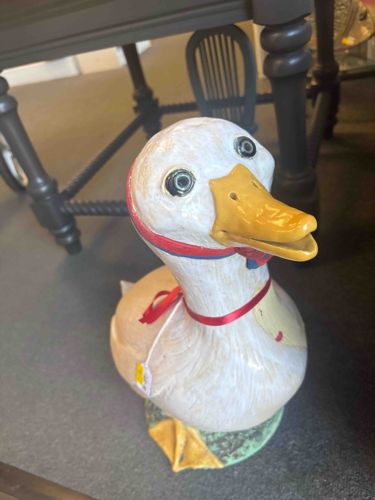
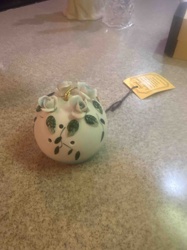
This item is a novelty ceramic duck figurine, likely intended as a decorative piece or a planter, though its primary function as a planter is not fully discernible without a top-down view. The figurine depicts a duck in a standing or seated position, characterized by a rounded body, an elongated neck, and a distinct head featuring prominent black eyes with white pupils, giving it a somewhat whimsical or cartoonish expression. The duck's 'plumage' is rendered in an off-white to cream color with visible brushstrokes creating a textured effect, suggesting hand-painting. The beak is a vibrant yellow-orange, and the webbed feet, visible at the base, are similarly colored. A notable decorative element is a red ribbon tied around the duck's neck, forming a bow, with additional strands of red ribbon visible elsewhere on the body, possibly indicating a festive or patriotic theme given the red, white, and subtle blue (on the bow knot) color scheme. There is a small white tag with a yellow or gold top attached to the ribbon on the duck's chest, which appears to be a price tag or identification tag. The figurine rests on a green base, which mimics grass or water, indicating it is a self-contained decorative object. The ceramic appears to be glazed, providing a glossy finish. There are no immediately visible signs of cracks or significant chips, suggesting it is in good, albeit used, condition. The style points towards a mid-20th century to contemporary manufacturing period, typical of kitschy or charming home decor. The craftsmanship is decent for a mass-produced or studio ceramic piece, with hand-painted details adding to its character.
AI Appraisal Report
Based on my visual examination of the provided image, this novelty ceramic duck figurine, owned by Fulton, appears to be in good condition with no immediately visible cracks or significant chips. The glaze is intact, contributing to its glossy finish. Authenticity as a mass-produced decorative ceramic piece from the mid-20th century to contemporary period seems self-evident given its style and typical manufacturing techniques. Its whimsical cartoonish features, hand-painted details, and general aesthetic are consistent with charming, albeit kitschy, home decor from that era.
Market conditions for such novelty ceramic figurines are generally modest. While decorative and appealing to collectors of specific themes or vintage decor, they are not typically rare or highly sought after, unless associated with a well-known manufacturer or artist, which is not indicated here. Comparable items found in online marketplaces, antique stores, and estate sales usually range from $10 to $40, depending on condition, size, and specific appeal. The red ribbon and what appears to be a price tag add to its character but don't significantly enhance intrinsic value.
The demand for general novelty ceramic ducks is low to moderate. While charming, these items are mass-produced, limiting rarity. Factors impacting value include its good condition and the pleasant aesthetic. Conversely, its common nature and lack of identifiable maker or historical significance limit its upper value.
It is important to note that without a physical inspection, I cannot definitively confirm the absence of hairline cracks, repairs, or manufacturer's marks on the base that might influence value. Furthermore, the precise material composition (type of ceramic) and the exact age are difficult to ascertain from images alone. Provenance documentation, if any, could also add to its historical context but is unlikely to dramatically increase its monetary value given its decorative nature.