AI estimate as of November 26, 2025 · verify with a professional before acting
AI-Generated · Verify before acting
Everything on this page is generated by AI for informational purposes only. AI can make mistakes — the AI may misidentify items or misattribute them (artist, maker, brand, designer, origin, era). This is not an official valuation and should not be used for insurance, sale, tax, estate, legal, or lending purposes — or any decision requiring a certified appraisal. It is not an authoritative claim about any person, brand, or rights holder — do not share or rely on it as a factual statement about a third party. Always consult qualified professionals before making financial decisions.
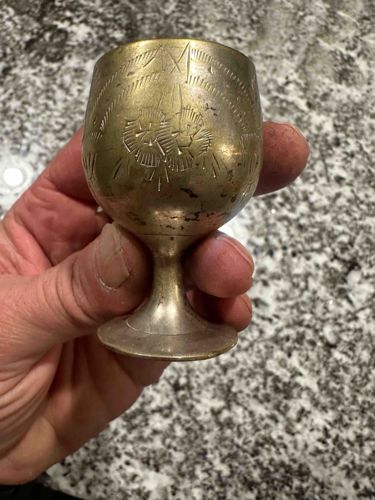
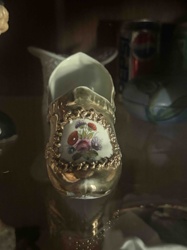
This item is a small, ornate goblet, presumably made of brass due to its golden-yellow metallic sheen and visible tarnishing. Its overall height appears to be approximately 2.5 to 3 inches, judging by its proportion when held in a hand. The goblet features a classic form with a bowl-shaped cup, a short stem, and a round, slightly flared base. The surface of the cup is extensively decorated with engraved or etched patterns. These patterns consist of radial lines and what appear to be stylized floral or starburst motifs, arranged in bands around the upper and middle sections of the cup. The etching exhibits a somewhat rustic or hand-tooled quality, suggesting traditional craftsmanship rather than mass machine production. The material shows significant signs of age and handling, including a darkened patina in recessed areas and general surface wear, minor scratches, and possibly some small areas of oxidation or discoloration, particularly visible near the rim and base. There is no visible maker's mark or signature; however, the style of decoration is reminiscent of folk art or items from regions known for brass and copper work, potentially Middle Eastern, Indian, or Eastern European, dating perhaps to the mid-20th century or earlier. The construction seems robust, indicating it was likely cast or spun and then decorated. The craftsmanship, while not perfectly symmetrical, points to a utilitarian yet decorative item, possibly used for ceremonial purposes, as a shot glass, or simply as an ornamental piece. The wear patterns suggest a history of use and handling.
AI Appraisal Report
This etched brass miniature goblet, while charming, presents as a decorative collectible with a relatively modest market value. Its condition, as observed from the image, indicates significant age and use, characterized by a darkened patina, surface wear, minor scratches, and some areas of oxidation. This wear is consistent with traditional brass items and contributes to its aged aesthetic rather than detracting significantly from its overall appeal for a collector of such items. Authenticity as handmade is plausible given the somewhat rustic and hand-tooled quality of the etching, which shows variations typical of artisan craftsmanship rather than precision machine production. The style of decoration, featuring radial lines and stylized motifs, is reminiscent of folk art from Middle Eastern, Indian, or Eastern European regions.
Market conditions for such small, un-marked decorative brass items are generally stable but do not command high prices. Comparables would include similar miniature brass goblets, shot glasses, or ornamental cups found in antique shops, flea markets, or online collectibles platforms. These items typically fall into the low to mid-range for decorative brass. Demand is steady among collectors of folk art, brassware, or curios, but it is not a highly sought-after category. Rarity is not a significant factor here; while unique in its specific handcrafted details, miniature brass goblets are not uncommon.
The lack of a visible maker's mark significantly limits its value, as identification of a specific artisan or region could increase its desirability. The primary factors impacting its value are its decorative appeal, age, and handmade character. Without in-person examination, I cannot definitively confirm the base metal or the exact age; scientific testing (such as XRF analysis) would be needed for metal composition, and a physical inspection would allow for a more thorough assessment of the etching technique and overall structural integrity. Provenance documentation, if available, would also be invaluable for authenticating its origin and age. However, based on visual evidence, it appears to be a genuine vintage decorative piece.