AI estimate as of September 5, 2025 · verify with a professional before acting
AI-Generated · Verify before acting
Everything on this page is generated by AI for informational purposes only. AI can make mistakes — the AI may misidentify items or misattribute them (artist, maker, brand, designer, origin, era). This is not an official valuation and should not be used for insurance, sale, tax, estate, legal, or lending purposes — or any decision requiring a certified appraisal. It is not an authoritative claim about any person, brand, or rights holder — do not share or rely on it as a factual statement about a third party. Always consult qualified professionals before making financial decisions.
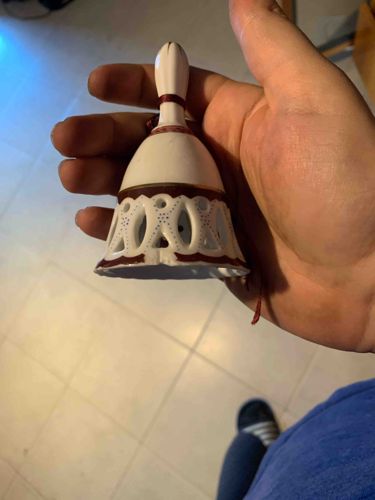
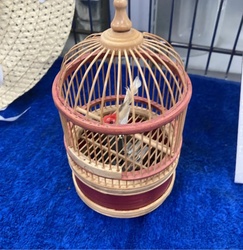
This item is a small, ornate decorative bell crafted from what appears to be porcelain or fine ceramic. Its primary color is a creamy white, accented strikingly with a deep reddish-brown or burgundy hue and subtle gold detailing. The bell features a classic bell shape, tapering from a wider, open mouth at the bottom to a narrower top that integrates into a rounded, finial-like handle. The most distinguishing characteristic is the pierced, openwork design circling the lower half of the bell, resembling intricate lace or filigree with repeating circular and diamond-shaped cutouts. The edges of these cutouts, as well as the rim of the bell and a band below the handle, are highlighted with the reddish-brown color, giving it a rich contrast. A thin gold line or trim is visible dividing the solid white upper section from the pierced lower section, and also potentially on the handle. There is a small string or ribbon, colored reddish-brown, tied just below the handle, which likely served as a clapper or purely decorative element, though no clapper is visible. The bell appears to be in good condition, with no overt chips, cracks, or extensive wear visible from the provided images, indicating good craftsmanship, with clean lines and detailed cutouts. The style suggests it could be from the mid-20th century to contemporary, possibly a collectible porcelain piece.
AI Appraisal Report
Based on my visual examination of the provided image, this decorative porcelain bell presents in good overall condition. There are no immediately apparent chips, cracks, or significant wear, which speaks to either careful handling or robust initial craftsmanship. The intricate pierced work, contrasting colors, and gold accents suggest it is a well-made piece, likely from a reputable manufacturer, possibly European, specializing in decorative porcelain.
Authenticity, based purely on visual inspection, is challenging. While the quality appears good, without a physical examination, I cannot confirm the exact material (porcelain vs. fine ceramic) or identify any manufacturer's marks, which are crucial for definitive authentication. Physical inspection would allow me to check for kiln marks, maker's stamps, or specific glaze characteristics consistent with known manufacturers. Provenance documentation, if available, would also be invaluable.
Regarding market conditions, decorative porcelain bells are a niche collecting area. While intricate designs like this one are desirable, the overall market for single, unbranded decorative bells is moderate. Comparables would include similar pierced porcelain bells, often from companies like Avon, Franklin Mint, or various European souvenir producers. Demand is driven by collectors with specific interests in porcelain bells or those seeking decorative accents. Rarity for such a piece, without a specific maker's mark or historical significance, is low to moderate; many such bells were produced. Factors impacting value positively are its good condition and pleasing aesthetic. Factors limiting value are its common form, lack of a visible maker's mark, and the general abundance of decorative bells.
To fully authenticate and refine the appraisal, an in-person examination is essential to identify maker's marks, assess the exact material and craftsmanship characteristics, and confirm the absence of subtle damages. Without this, the appraisal remains an estimation based on visual attributes commonly found in this decorative collectible segment.