These notes were written by the person who submitted this item. Appraiser.AI has not verified them, and the AI's identification and estimate may rely on them.
AI Estimated Value
Not an official valuation
$60 - $90
AI estimate as of July 5, 2025 · verify with a professional before acting
AI-Generated · Verify before acting
Everything on this page is generated by AI for informational purposes only. AI can make mistakes — the AI may misidentify items or misattribute them (artist, maker, brand, designer, origin, era). This is not an official valuation and should not be used for insurance, sale, tax, estate, legal, or lending purposes — or any decision requiring a certified appraisal. It is not an authoritative claim about any person, brand, or rights holder — do not share or rely on it as a factual statement about a third party. Always consult qualified professionals before making financial decisions.
This analysis also relies on unverified notes provided by the user, which may be incomplete or inaccurate and could affect the result.
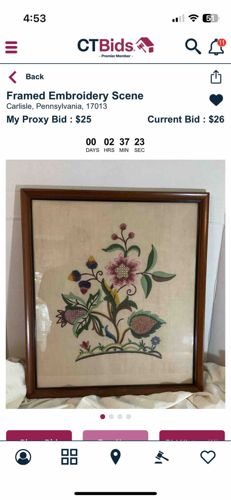
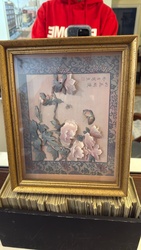
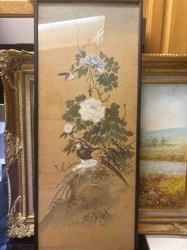
This appears to be a framed embroidery scene, likely a needlepoint or crewel work, depicting a botanical motif. The central imagery features an arrangement of stylized flowers and foliage, primarily in shades of green, pink, purple, and blue, with accents of yellow and brown. The stitching appears to be varied, suggesting different textures and depth, and might include traditional embroidery stitches such as satin stitch, chain stitch, or French knots. The background fabric is a light, neutral color, possibly linen or cotton, which has a slightly aged or discolored appearance, consistent with older textiles. The piece is housed within a rectangular wooden frame with a warm, reddish-brown stain and a subtle, possibly beveled edge. The frame itself seems to be in good condition, showing minimal signs of wear or damage. The overall dimensions are stated as 19x21.5 inches, indicating a modest size suitable for wall hanging. The embroidery itself shows good craftsmanship, with stitches appearing relatively uniform and neatly executed, suggesting a handmade piece. There are no immediately visible rips, tears, or significant stains on the embroidery, though some slight discoloration or fading might be present due to age. Without closer inspection, it is difficult to determine the exact age, but the style of the floral arrangement and the general aesthetic suggest it could be a vintage piece, possibly mid-20th century or earlier. There are no discernible maker's marks or signatures visible from the image.
AI Appraisal Report
Upon visual examination of this framed botanical embroidery, I assess it as a well-executed piece of vintage textile art, likely created in the mid-20th century. The needlework, possibly crewel or a similar style, displays competent craftsmanship with varied, neat stitches creating a pleasing textural quality. The floral composition is traditional and aesthetically balanced. The subject matter, while charming, is quite common for home embroidery of this era. The textile appears to be in good vintage condition, with some expected, uniform age-related toning to the background fabric but no major stains, tears, or fading evident in the photograph. The simple wooden frame is appropriate for the period and appears to be in good condition.
The market for anonymous, mid-century embroidery pieces like this is primarily decorative. Value is driven by visual appeal, condition, and craftsmanship rather than artist recognition or historical rarity. Similar handcrafted textile art of this size and quality typically sells in the lower-end of the decorative arts market. The primary factor limiting the value is its lack of a signature or provenance, which prevents attribution to a known artist or workshop.
It is crucial to note the limitations of this appraisal, as it is based solely on images. A physical inspection would be required to fully assess the condition of the fibers, identify the specific stitch types, and examine the back of the work for construction details or hidden signatures. Without de-framing, the full condition of the textile's edges cannot be confirmed. Definitive dating or authentication would require fiber analysis and comparison with documented examples from specific periods, which is beyond the scope of a visual inspection.