AI Appraisal Estimate

AI-generated estimates · not official valuations

From the user

What was submitted

Photo and notes provided by the user — not generated by AI

Submitted item photo
Submitted photo · May 23, 2026

User's notes

No additional notes provided.

AI analysis below

AI appraisal

AI analysis & estimate

AI-Generated · Verify before acting

Everything below is generated by AI for informational purposes only. AI can make mistakes — the AI may misidentify items or misattribute them (artist, maker, brand, designer, origin, era). This is not an official valuation and should not be used for insurance, sale, tax, estate, legal, or lending purposes — or any decision requiring a certified appraisal. It is not an authoritative claim about any person, brand, or rights holder — do not share or rely on it as a factual statement about a third party. Always consult qualified professionals before making financial decisions.

Read the full disclaimer

AI Identification

·Not independently authenticated·Verify before acting

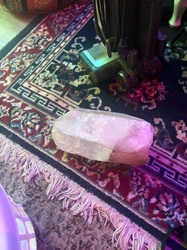
Rough-Cut Selenite Block

Mineral Specimen

AI Estimated Value

·Not an official valuation·Verify before acting

$75 - $125

As of May 23, 2026

AI Item Analysis

·AI can make mistakes·Verify before acting
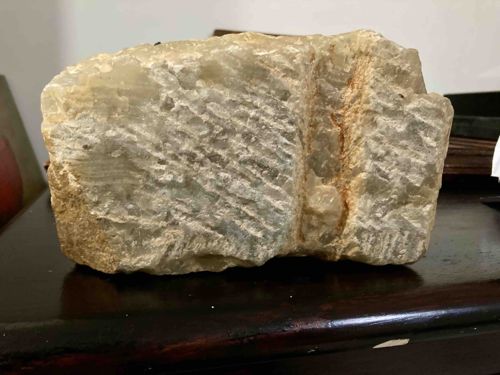
This item is a substantial, roughly rectangular block of what appears to be selenite, a crystalline variety of gypsum. The overall color is a translucent milky white to light beige, with various earthy tones ranging from light brown to subtle grey mottling interspersed throughout its surface. Its dimensions suggest a considerable mass, likely making it suitable as a decorative specimen or for certain spiritual and healing practices due to the energetic properties often attributed to selenite. The surface is characterized by a mix of textures: some areas show distinct cleavage planes that are typical of selenite, appearing somewhat striated or layered, while other sections are more rugged and uneven, indicating natural breaks and unpolished surfaces. There are prominent linear indentations and grooves running across some faces, which might be natural formations or potentially marks from the extraction process. A notable feature is a vertical streak of a more intense, rusty-brown color running down one side, suggesting mineral inclusions or iron staining. The edges are largely unrefined and show the natural fracture patterns of the material. There are no visible maker's marks or signatures, consistent with a raw or minimally processed mineral specimen. The condition is as expected for a natural mineral, with no apparent damage beyond its inherent ruggedness. The specimen displays good clarity in its more translucent areas, along with the characteristic fibrous or satin spar texture often found in selenite.

AI Appraisal Report

·AI can make mistakes·Verify before acting
Based on my visual examination of the provided image, this Rough-Cut Selenite Block appears to be an authentic specimen of natural selenite. The characteristic translucent milky white to light beige coloration, along with the visible cleavage planes, striated textures, and fibrous appearance in more translucent areas, are all consistent with selenite. The earthy tones, linear indentations, and rusty-brown mineral inclusions are typical natural variations for this material. The condition appears to be very good, consistent with a naturally occurring, unpolished mineral specimen. There are no signs of abnormal damage or alterations beyond its inherent rough-cut nature. In terms of market conditions, selenite is a relatively common and readily available mineral. While specimens of this size and rough-cut form are popular for decorative purposes and metaphysical practices, they do not typically command high prices unless they possess exceptional clarity, unusual formations, or significant rarity. This particular piece, while substantial, does not exhibit features that would place it in a higher tier of rarity or demand compared to similar large rough selenite blocks on the market. Factors impacting its value include its size and its natural aesthetic appeal as a decorative or spiritual item. However, its common availability and the lack of unique or historically significant attributes keep the value in the modest range. Demand is stable but not exceptionally high for unrefined specimens of this type. My assessment for authenticity and condition is based solely on visual inspection of the image. For a full authentication, an in-person examination would be crucial to physically assess its weight, internal structure, hardness, and to confirm the absence of any artificial enhancements or treatments. Provenance documentation, though unlikely for a raw mineral, would also provide additional verification of its origin.

Get your items appraised

Instant estimates of your treasures with AI-powered appraisals

Browse More Appraisals