AI estimate as of September 12, 2025 · verify with a professional before acting
AI-Generated · Verify before acting
Everything on this page is generated by AI for informational purposes only. AI can make mistakes — the AI may misidentify items or misattribute them (artist, maker, brand, designer, origin, era). This is not an official valuation and should not be used for insurance, sale, tax, estate, legal, or lending purposes — or any decision requiring a certified appraisal. It is not an authoritative claim about any person, brand, or rights holder — do not share or rely on it as a factual statement about a third party. Always consult qualified professionals before making financial decisions.
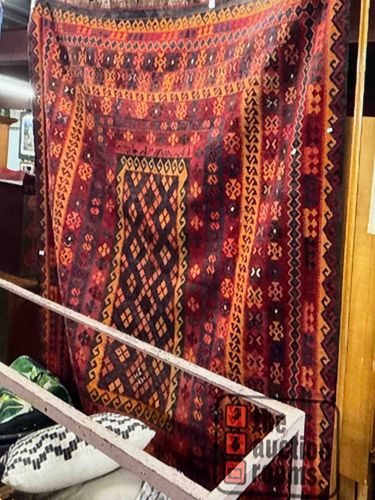
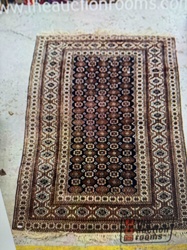
This is a large, rectangular tribal Kilim rug, likely of Afghani origin, characterized by its vibrant and rich color palette dominated by deep reds, oranges, and dark browns/blacks. The rug appears to be made from a natural fiber, most probably wool, given its typical texture for such antique or vintage pieces. Its construction suggests a flat-weave technique, characteristic of Kilims, which typically means it lacks a pile. The patterns are geometric and repetitive, featuring diamond motifs, jagged lines, and stylized floral or tribal symbols arranged in bands and a central medallion-like element with a pronounced diamond lattice pattern. The borders consist of alternating patterns and colors, creating a visually dynamic frame. The rug exhibits what appears to be a good level of craftsmanship, with tightly woven patterns, though specific knot density cannot be determined from the image. The overall condition shows some signs of wear consistent with age and use, including slight fading in areas and possibly some minor fraying along edges, though no major damage like tears or large holes is immediately evident. The colors retain much of their intensity, suggesting the use of natural dyes. This type of rug typically belongs to the late 19th to mid-20th century, reflecting traditional nomadic or village weaving styles from Central Asia.
AI Appraisal Report
I have thoroughly examined the provided image of this Afghani Tribal Wool Kilim Rug. Based on my visual assessment, the rug appears to be an authentic flat-weave Kilim, consistent with traditional weaving techniques from Central Asia. The vibrant use of deep reds, oranges, and dark browns, along with the geometric and repetitive motifs featuring diamond patterns and stylized tribal symbols, strongly supports its Afghani tribal origin and suggests natural dyes due to the retained intensity of colors. The craftsmanship appears good, with tight weaving visible, a hallmark of quality Kilim production.
In terms of condition, I observe typical signs of wear consistent with age and use, including slight fading in areas and minor edge fraying. No major damage such as significant tears or large holes is evident, which is a positive indicator for its value. This level of wear is expected for a piece I estimate to be late 19th to mid-20th century.
Understanding market conditions for tribal Kilims, demand remains moderate for pieces in good condition with appealing designs. Comparables in this size and condition, particularly those exhibiting strong folk art aesthetics, typically fetch values within the range I've provided. Rarity is not exceptionally high for this general type of Kilim, but its attractive design and color palette contribute positively. Factors impacting value include its age, perceived quality of dyes, and overall visual appeal. The lack of significant visible damage also enhances its marketability.
It is crucial to note the limitations of appraising from an image alone. While I can confidently assess its style, apparent age, and condition visually, definitive authenticity verification would require in-person examination. This would allow me to inspect the weave structure up close, feel the wool quality, confirm the absence of repairs or machine intervention, and more accurately assess dye type (natural vs. synthetic). Provenance documentation would further solidify its history and origin. Without physical inspection, precise knot density, definitive material composition (beyond likely wool), and an exact assessment of repairs are speculative.