AI Appraisal Estimate

AI-generated estimates · not official valuations

From the user

What was submitted

Photo and notes provided by the user — not generated by AI

Submitted item photo
Submitted photo · June 13, 2026

User's notes

No additional notes provided.

AI analysis below

AI appraisal

AI analysis & estimate

AI-Generated · Verify before acting

Everything below is generated by AI for informational purposes only. AI can make mistakes — the AI may misidentify items or misattribute them (artist, maker, brand, designer, origin, era). This is not an official valuation and should not be used for insurance, sale, tax, estate, legal, or lending purposes — or any decision requiring a certified appraisal. It is not an authoritative claim about any person, brand, or rights holder — do not share or rely on it as a factual statement about a third party. Always consult qualified professionals before making financial decisions.

Read the full disclaimer

AI Identification

·Not independently authenticated·Verify before acting

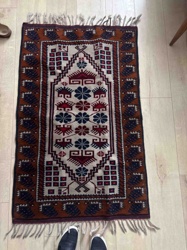
Baluch Rug

Textile Art / Floor Covering

AI Estimated Value

·Not an official valuation·Verify before acting

$300-600

As of June 13, 2026

AI Item Analysis

·AI can make mistakes·Verify before acting
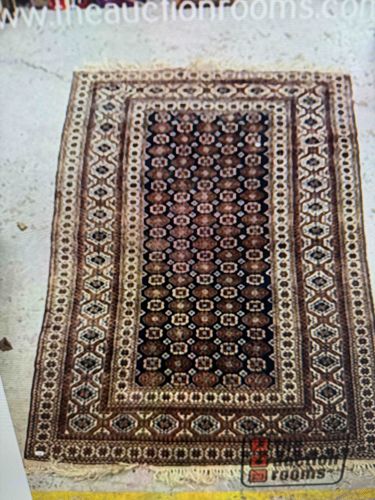
This item is a rectangular hand-knotted Baluch rug, likely Persian or Afghan in origin, characterized by its traditional geometric patterns and darker color palette. The physical dimensions appear to be a runner or a small area rug, although exact measurements are not discernible from the image. It features a central field with repeating medallions or stylized floral motifs, predominantly in shades of dark brown, black, and cream/light beige, creating a rich contrast. The main field is bordered by several intricate bands. The inner border consists of a chain-like pattern, while the outer borders display a series of interconnected diamond or octagonal motifs, also in contrasting dark and light tones. The materials appear to be wool for the pile, known for its durability and natural luster, woven on a cotton or wool foundation. The fringes at both ends are visible and appear to be in a natural, undyed state, showing some signs of wear and slight discoloration, typical for an older or well-used textile. The overall condition suggests a vintage or antique piece, with expected patina and some wear consistent with age and use, visible in the slight fading and softened outlines of the patterns. The craftsmanship indicates hand-knotted construction, a labor-intensive process that contributes to the rug's quality and longevity. The tight knotting and detailed patterns are indicative of the skill involved in its creation. There are no clear manufacturer's marks or signatures visible in the provided image. The style period is characteristic of 20th-century Baluch weaving, probably mid-century or earlier, given the dyes and stylistic elements.
AI Appraisal Report

·AI can make mistakes·Verify before acting
I have examined the provided image of this hand-knotted Baluch rug. Its rectangular shape and geometric patterns, along with the characteristic dark color palette of brown, black, and cream, are consistent with Baluch weaving, likely from Persia or Afghanistan. The craftsmanship suggests hand-knotted construction, and the wool pile on what appears to be a cotton or wool foundation supports its authenticity as a traditional rug. The overall condition indicates a vintage piece, exhibiting expected wear such as slight fading and softened outlines of patterns, especially noticeable in the fringes. This patina is consistent with age and use, aligning with a potential 20th-century, possibly mid-century or earlier, stylistic period. Market conditions for Baluch rugs of this type are generally stable, with a moderate demand for good quality vintage examples. While not exceedingly rare, a well-preserved piece with attractive patterns holds appeal. Factors impacting its value negatively include the evident wear and the commonality of the design. Positive factors include its hand-knotted nature and the desirability of authentic tribal pieces. A limitation in this appraisal is the inability to fully verify authenticity and condition from images alone. A physical examination would allow for a precise knot count, assessment of dye quality (natural vs. synthetic, which impacts value significantly), detailed inspection of pile height and wear, and a more accurate size measurement. Provenance documentation, if available, would further authenticate its origin and age. Without these, my assessment of condition and origin is based purely on visual cues, which can be deceptive.

Get your items appraised

Instant estimates of your treasures with AI-powered appraisals

Browse More Appraisals