AI estimate as of October 17, 2025 · verify with a professional before acting
AI-Generated · Verify before acting
Everything on this page is generated by AI for informational purposes only. AI can make mistakes — the AI may misidentify items or misattribute them (artist, maker, brand, designer, origin, era). This is not an official valuation and should not be used for insurance, sale, tax, estate, legal, or lending purposes — or any decision requiring a certified appraisal. It is not an authoritative claim about any person, brand, or rights holder — do not share or rely on it as a factual statement about a third party. Always consult qualified professionals before making financial decisions.
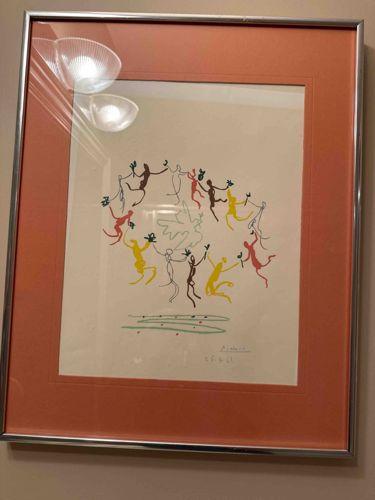
This item is a framed art print, specifically an apparent lithograph or serigraph, of Pablo Picasso's 'Ronde de la Jeunesse' (Youth's Round Dance). The artwork depicts a circular formation of stylized, dancing figures, rendered in various colors including red, yellow, dark brown/black, and a light outline. The central figure appears to be a dove, also outlined. Below the dancing figures, there are horizontal dashed lines in green, perhaps representing grass or a ground plane. The overall composition is playful and emblematic of Picasso's later, more graphic works. The print is housed within a silver-toned metal frame, likely aluminum, with a clean and minimalist profile. It is matted with a wide, orange-peach colored mat board, which complements the warm tones in the print. Visible signatures and dates are present in the lower right corner of the print, reading 'Picasso' with a date of '25.6.61' (June 25, 1961), suggesting its creation date. The print itself appears to be in good condition with no immediate visible damage or significant discoloration; however, reflections on the glazing obscure some details. The frame shows some minor wear at the top edge, consistent with age and handling. This specific print is a representation of a famous artwork, indicating its potential as a collectible item from the mid-20th century. The quality of the reproduction (e.g., whether it's a signed limited edition or a poster print) would significantly impact its value, which cannot be determined from the image alone. The craftsmanship of the framing seems professional, contributing to the overall presentation.
AI Appraisal Report
Upon examining the provided images, I have assessed this framed art print of Pablo Picasso's 'Ronde de la Jeunesse' (Youth's Round Dance). The item presents as a reproduction of the famous 1961 work, housed in a minimalist aluminum frame with an orange-peach mat. The print and matting appear to be in good condition, with no visible fading, foxing, or damage, though some light reflections obscure a complete view. The frame exhibits minor wear consistent with its age and handling.
The primary factor dictating value for this piece is its nature as a reproduction. The signature and date ('Picasso 25.6.61') present are part of the print itself (in-plate) and do not represent a hand-signed signature. Without evidence of being part of a limited, artist-approved, and numbered edition (such as 'épreuve d'artiste' or a specific edition number like '5/100'), this item is considered a decorative poster or open-edition print. These were produced in large quantities and are widely available on the secondary market.
Market comparables for unsigned, open-edition poster prints of 'Ronde de la Jeunesse' consistently sell in the low three-figure range, with custom framing contributing a minor portion of the value. Demand for Picasso posters remains steady, but their abundance prevents significant appreciation. Therefore, the value is primarily decorative.
**Limitation of Appraisal:** This appraisal is based solely on visual examination of images. A definitive valuation and authentication would require in-person inspection to determine the printing method (lithograph, serigraph, or offset print), examine the paper for watermarks or embossments, and de-frame the piece to check for any publisher marks or edition numbers. Verifying a hand-signed signature, if one were claimed, would necessitate comparison with known authentic signatures or expert authentication services.