AI estimate as of November 6, 2025 · verify with a professional before acting
AI-Generated · Verify before acting
Everything on this page is generated by AI for informational purposes only. AI can make mistakes — the AI may misidentify items or misattribute them (artist, maker, brand, designer, origin, era). This is not an official valuation and should not be used for insurance, sale, tax, estate, legal, or lending purposes — or any decision requiring a certified appraisal. It is not an authoritative claim about any person, brand, or rights holder — do not share or rely on it as a factual statement about a third party. Always consult qualified professionals before making financial decisions.
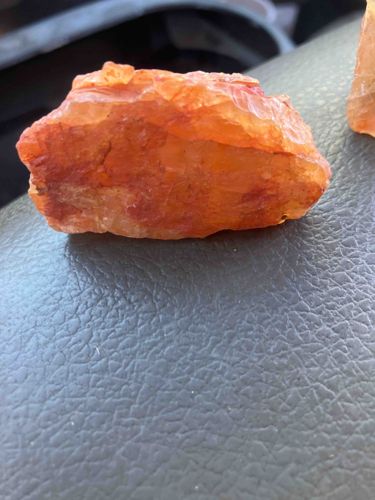
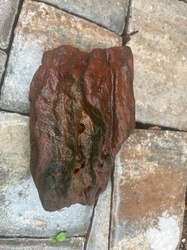
The item is a rough, unpolished specimen of what appears to be Carnelian, a translucent reddish-orange variety of chalcedony. It is irregularly shaped, consistent with a naturally fractured or unworked mineral piece. The color varies from a deeper, opaque reddish-brown in some areas to a brighter, more translucent orange and amber in others, showcasing the typical color zoning found in natural Carnelian. The surface is uneven and rugged, with multiple facets and cleavage planes characteristic of a raw stone. Some areas exhibit a slightly waxy or resinous luster where light reflects off flatter surfaces, while other parts are duller and more fractured. There are no discernible manufacturing marks, signatures, or stamps, indicating it is an unprocessed geological specimen. Its size appears to be relatively small, likely fitting in the palm of a hand, judging by its placement on what looks like a car's dashboard or seat upholstery. There are no obvious signs of significant damage or repairs; the current condition reflects its natural, unadulterated state. The quality of the material appears good for an uncut specimen, with vibrant color and a degree of translucency in thinner sections. It does not appear to be an artifact, but rather a naturally occurring mineral piece, possibly intended for lapidary work, crystal healing, or as a collector's specimen. The visible imperfections are natural formations rather than wear or damage.
AI Appraisal Report
Based on my visual examination of the provided image, I assess this rough Carnelian specimen. Its condition is excellent; it appears to be a natural, unadulterated piece with no signs of polishing, cutting, or damage beyond its natural fracture planes. The varied reddish-orange to amber coloration, typical of natural Carnelian with some zoning, suggests authenticity, and the rugged, uneven surface is consistent with a raw mineral specimen. There are no manufacturing marks, supporting its unprocessed status. The size, likely fitting in a palm, and its rough state indicate it is a specimen for collection, lapidary purposes, or metaphysical use.
Market conditions for rough Carnelian like this are generally stable but with low values for individual small pieces. Comparables on online marketplaces and crystal/mineral retailers typically range from a few dollars to twenty dollars for similar unpolished, unexceptional specimens. Demand is consistent among hobbyists and those interested in holistic practices, but it is not rare. The primary factors impacting its value are its natural beauty (color saturation, translucency), and size, and while this piece has good color, it lacks exceptional size or crystal formation to command a higher price point.
It is imperative to note the limitations of image-based appraisal. While the visual characteristics strongly suggest genuine Carnelian, full authentication would require in-person examination to assess specific gravity, hardness, and internal consistency. Spectroscopic analysis could definitively confirm mineral composition, but for an item of this value, such testing is generally not cost-effective or necessary. The provenance, if available, could offer additional certainty regarding its origin.